Artificial Intelligence’s impact on jobs remains a hotly debated topic, but what if the revolution isn’t about taking away jobs but creating more instead?
Early evidence reveals just that. AI-related hirings in Asia are far outstripping firings. AI is already creating winners and losers in the job market, with entry-level jobs waning and seniority coveted.
The full impact of AI on the labor market may take years to materialize, so continuous monitoring of labor market data remains essential.
What theory says
Economic theory suggests that AI has two opposing forces on the job market:
- Complementary effect: Boosting worker productivity, lowering costs, expanding market demand and generating new job types.
- Substitution effect: Automating routine tasks and replacing human labor.
In most economies, both forces operate simultaneously.
What the evidence suggests
That was the theory. Over three and a half years since the launch of generative AI models, we sought empirical evidence on how AI has transformed Asia’s job market.
Labor market data in Asia are fragmented, so to answer this question, we aggregated public news announcements by companies on both job losses and new hirings as a result of AI.
Our sample comprised 69 announcements across Asia, mostly covering the period from 2022 until August 2026*, alongside country-level surveys to assess the trends.
The net impact of AI on jobs has been positive
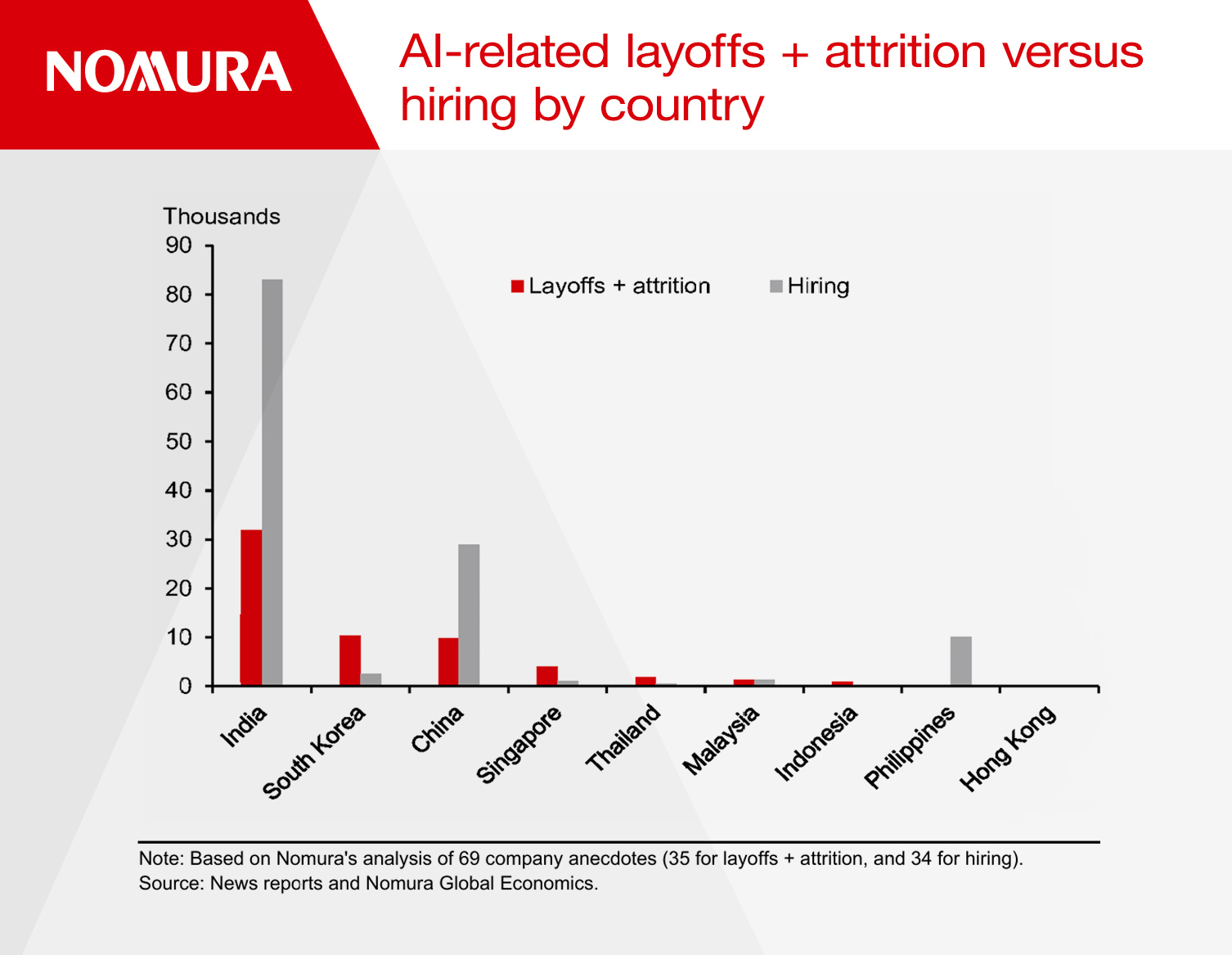
Our findings showed AI-related hirings totaled 131K jobs versus AI-related firings of 61K. This means that, in the early days of the AI revolution, the complementary effect (job gains) is more than offsetting the substitution effect (job losses). This holds true across major economies like India and China, as well as the back office-driven Philippine market. However, displaced workers rarely transition directly into AI engineering roles, so these aggregate figures may mask significant underlying distributional pain.
AI-related layoffs are concentrated in financial services and technology
- Financial services: Accounted for ~58% of documented AI-related layoffs. Banks are actively expanding branches while reducing overall headcount, demonstrating that AI allows business growth with leaner teams.
- Technology: Represented ~30% of AI-related job cuts.
- Physical & high-touch sectors: Layoffs in manufacturing, construction, healthcare direct care and education remain minimal, pointing to AI’s current limitations in automating physical and complex interpersonal tasks.
Roles replaced versus those created by AI
- Roles replaced: Displacements are heavily concentrated in lower-skilled or routine jobs, including banking back-office tasks (reconciliation, compliance, data entry), customer service (chatbots replacing support) and junior technical roles (QA testing, entry-level coding).
- Newly created roles: The largest block of verifiable hiring resides in data work, such as data annotation, AI training and data operations. However, the long-term durability of these entry-level data roles remains uncertain, as evolving models may eventually automate them as well.
“Silent firing” instead of layoffs
Instead of firing workers, many firms have resorted to slowing hiring or implementing hiring freezes to adjust to the AI era. In India, staffing firm Xpheno estimates that Indian IT net hiring fell from 600K in FY22 to 140K in FY26, as firms reduced campus recruitment, rather than terminating existing staff. South Korean banks have lowered the voluntary retirement age to 40, offering generous packages rather than forcing exits.
These “silent” layoffs are politically less visible than mass layoffs.
AI-related hiring dominates in the technology sector
Over 90% of total AI job creation remains locked within the technology sector itself, compared to less than 10% across all other sectors combined. In India, hiring has primarily centered on data annotation and linguistics, while in China, it has leaned toward high-skilled graduates focused on developing and scaling proprietary models.
Outside tech, non-technology sector hiring remains limited to niche roles, such as AI risk analysts in banking or autonomous vehicle specialists.
K-shaped split: Entry-level squeeze versus senior talent
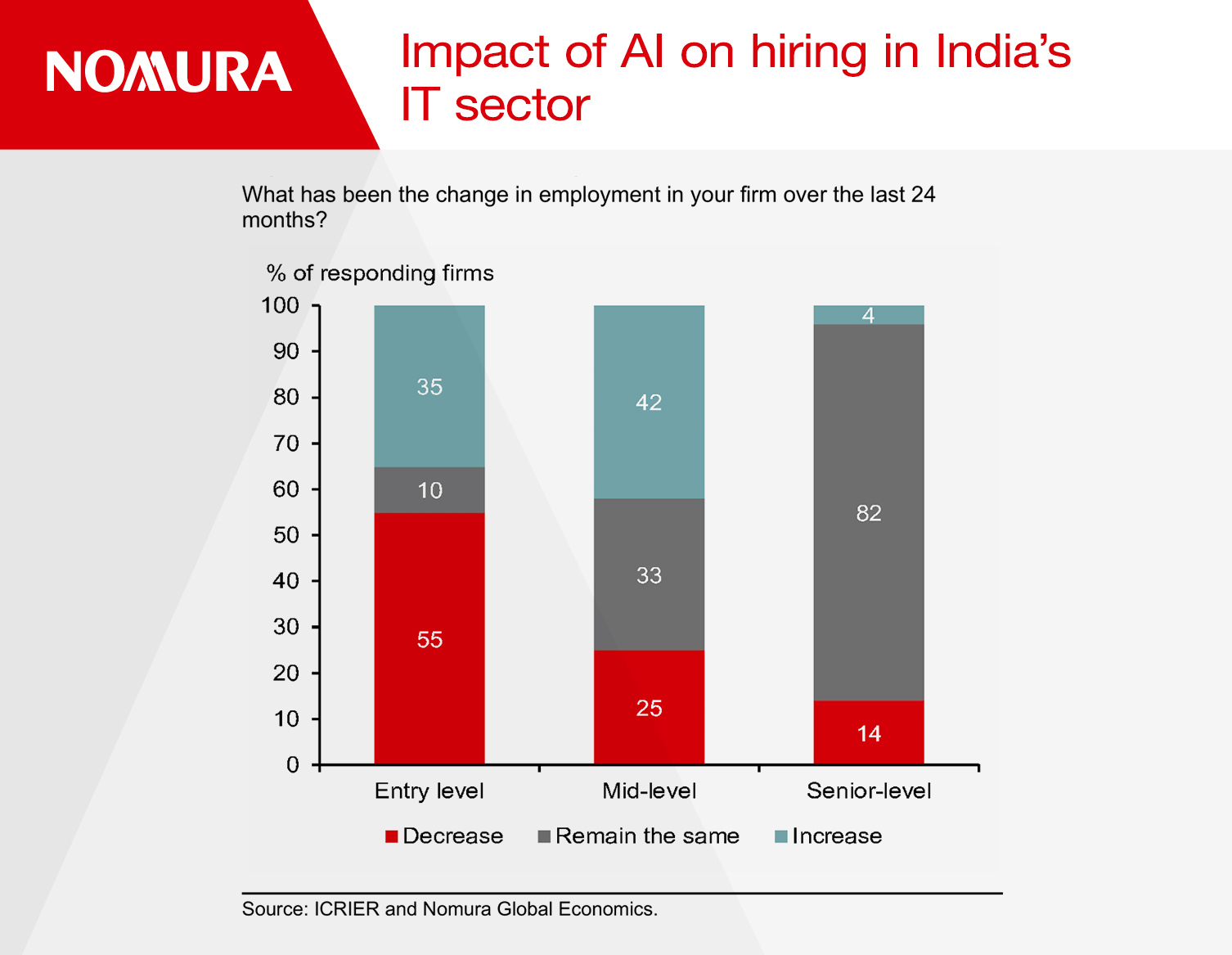
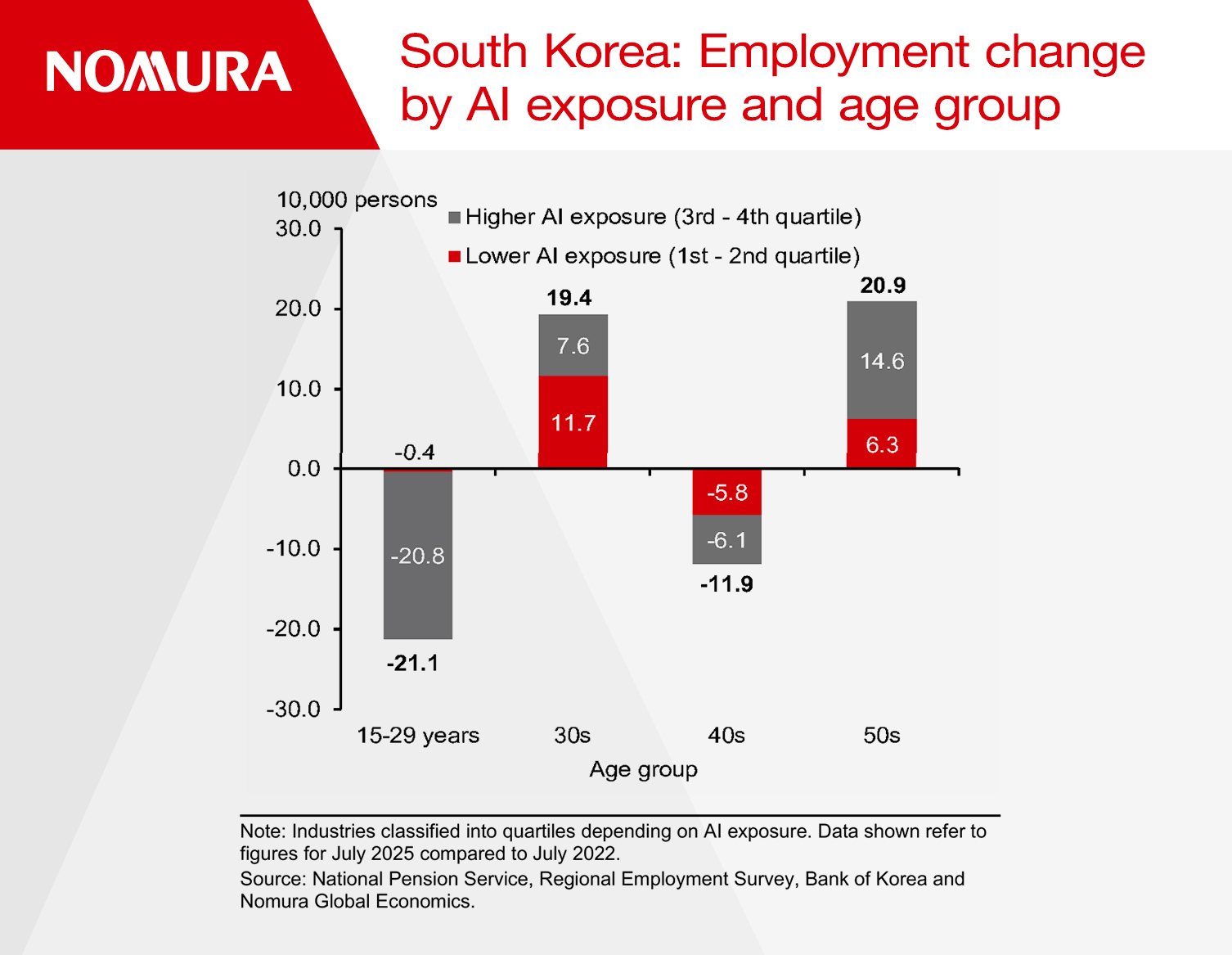
AI is establishing a two-tiered, K-shaped labor market characterized by declining demand for entry-level workers and rising demand for senior talent, who have a deeper understanding of the business context, interpersonal skills and organizational management, which AI cannot replicate.
- India: Based on an Indian Council for Research on International Economic Relations survey of 651 firms across the IT sector, 55% of the firms reported a decline in entry-level hiring, whereas only 14% reported a decline for senior-level roles.
India serves as ground zero for Asia’s labor disruption
Given its population size and role as the world's primary back-office and IT-services hub, India has experienced the largest absolute impact from AI across layoffs and hiring. Most firing cases are support teams replaced by chatbots, while most hiring cases are IT-services graduates that firms explicitly attribute to AI demand.
So far, the net impact of AI has been positive for India.
Key takeaways
- AI is spreading much faster than past technological innovations. Its evolution from task automation to agentic systems and potentially AGI (Artificial General Intelligence) means long-term labor structural changes will evolve over years.
- AI has been a net positive for jobs. While it runs counter to the negative news narrative, it does mimic the historical experience with technological adoption (e.g., the steam engine, electricity, the internet), which initially eliminated specific tasks but ultimately created more jobs.
- Most of the jobs created by AI so far appear directly linked to AI-related technology roles. We have not seen the indirect spillovers yet. As AI adoption picks up, we would expect the creation of more jobs in non-tech sectors.
- AI is producing winners and losers in the job market. It is reshaping labor markets: reducing entry-level jobs while favoring seniority. With youth unemployment already elevated, this could deepen socioeconomic strains.
- For policymakers, the uneven impact of AI on jobs calls for active policy intervention. This should combine income support, targeted mid-career reskilling and educational reform.
To read the full report, click here.