Europe's renewable energy transformation is a golden multi-decade infrastructure opportunity with policy makers striving to accelerate market integration and solve grid constraint challenges, according to senior executives at Nomura Greentech’s Sustainable Leaders Summit in Salzburg, Austria.
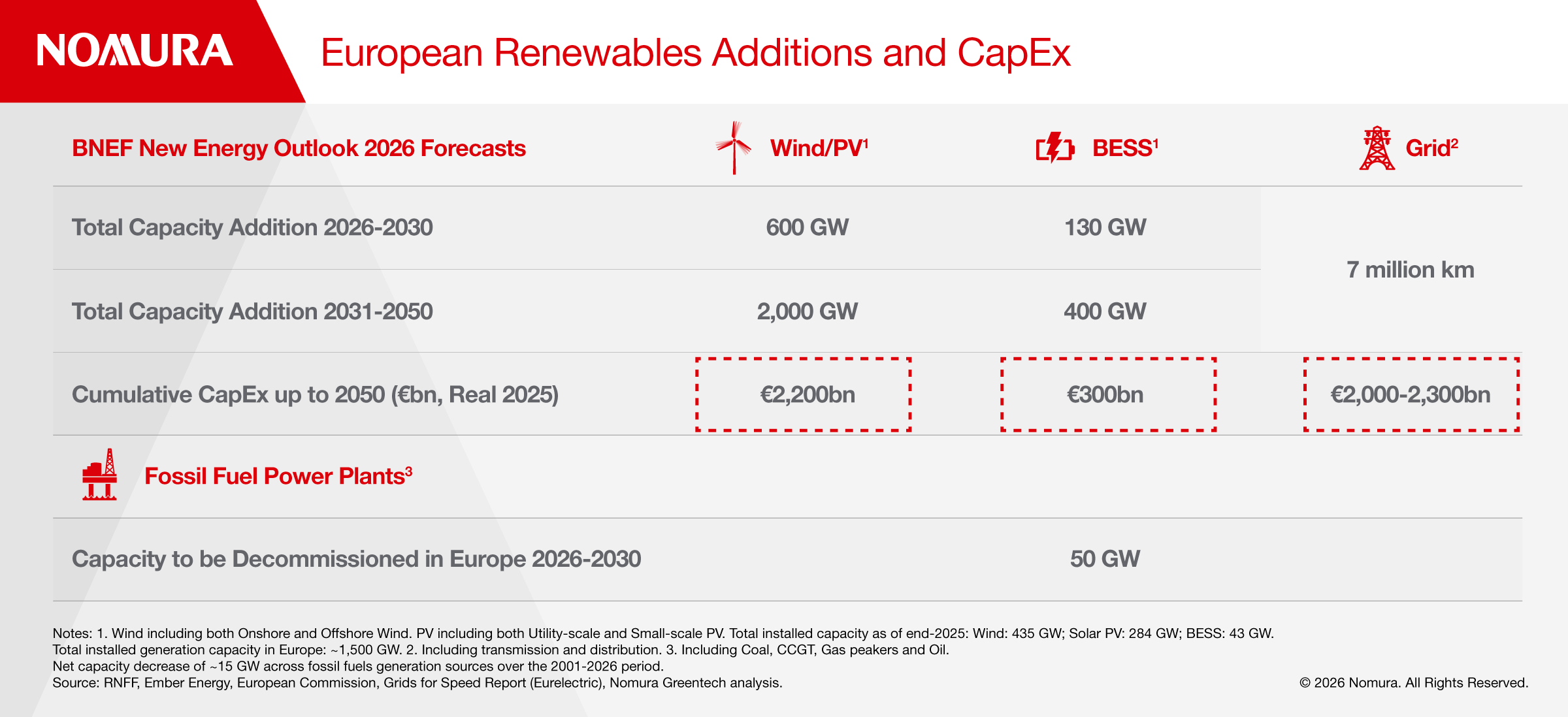
The scale of Europe's renewables requirement stands at a massive €2.2 trillion in capital expenditure through 2050 for wind and solar alone, according to BNEF data. This is being driven by power demand from electric vehicles, and digital infrastructure, which are expanding at a 12.3% compound annual growth rate and 9.2%, respectively. In addition, Europe must retire 50 GW of fossil fuel generation, including coal, by 2030, creating immediate replacement demand. Overall, European power consumption is projected to grow more than 70% to 4,980 TWh by 2050.
At the same time, what is required to supercharge further rollout of renewables, is enabling system integration and building out the grid infrastructure, which go hand in hand with renewables growth. The grid needs reconfiguring to manage millions of localized wind and solar sources rather than dozens of centralized power stations. Seven million kilometers of network expansion and €2-2.3 trillion in infrastructure investment is needed to accommodate distributed generation and manage intermittency.
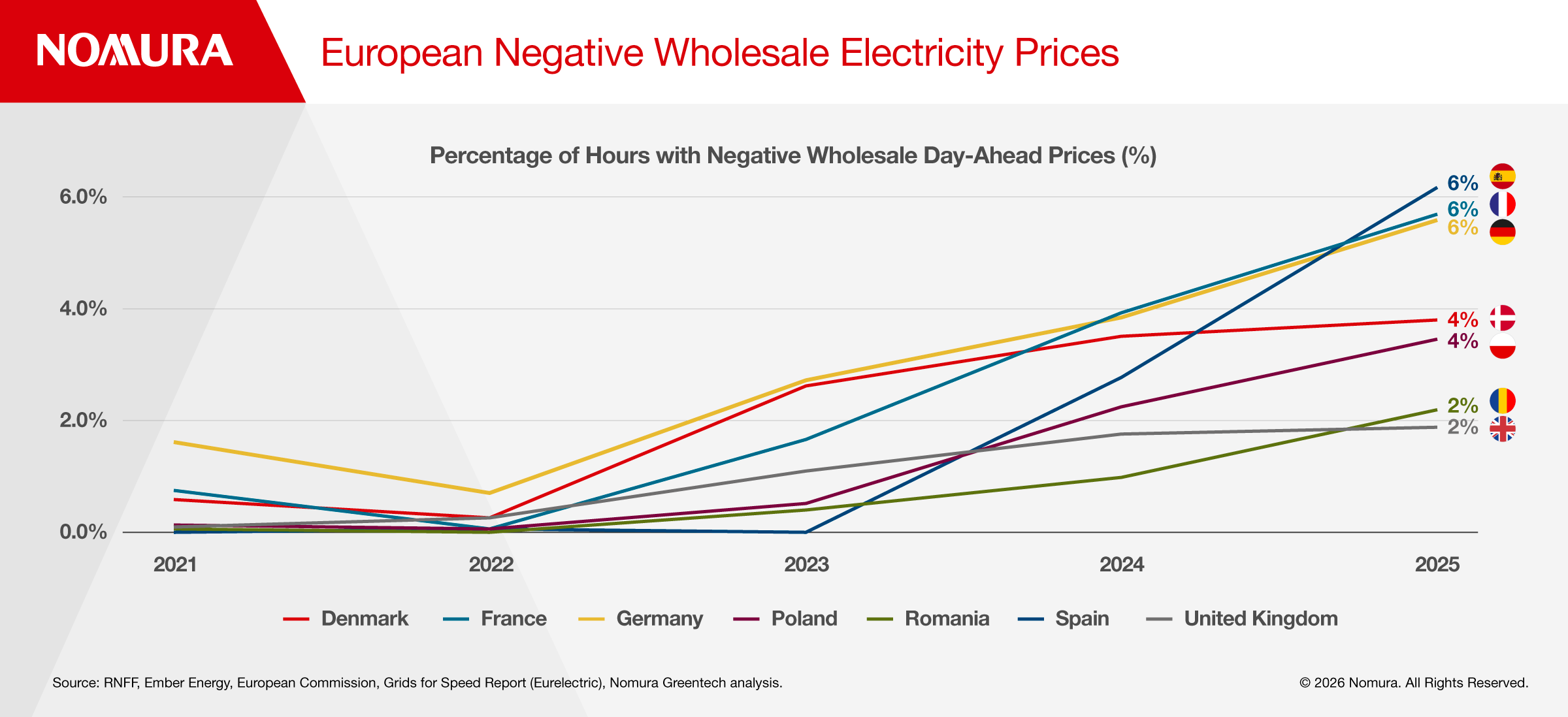
However, we have recently seen the rise of negative wholesale pricing hours, demonstrating that the grid infrastructure is lagging behind demand. Negative hours reached 6% in Denmark and France during 2025 as solar and wind saturation reduces prices during low-demand periods such as weekends and holidays. Wholesale price dispersion across Europe remains wide, ranging from €40/MWh to €122/MWh.
Market fragmentation and the convergence question
In addition, Europe's renewable energy market is not a single integrated system but a patchwork of national regimes with divergent regulatory frameworks, and pricing dynamics. While major interconnectors - high voltage power cables linking energy grids in neighbouring countries - are under construction and planned, progress is uneven, and market coupling is still a work in progress. The suspension of the 1.4 GW Sweden-Germany interconnector highlights the political and technical barriers to cross-border integration. This fragmentation creates localized supply-demand imbalances, worsening negative pricing in oversupplied markets while leaving others capacity-constrained. Another challenge is the permitting bottleneck with developers often contending with red tape before new projects are approved. That said, the European Commission is implementing measures to streamline and fast track permitting.
Taken together, this means that investors must navigate a series of micro-markets with distinct risk-return profiles weighing up their relative attractiveness as the investment differs across countries and technologies. It means that asset location and market selection are as critical as technology choice. In its current state the most attractive markets are Germany & Poland within Continental Europe whereas the Nordic markets remain more challenging.
The unit economics challenge
Meanwhile, capital costs have not fully normalized: offshore wind, onshore wind, solar PV, and battery storage capital expenditure remain elevated compared to 2018 baselines despite some retreat from 2022-2023 peaks. The cost of capital has also reset higher following the inflation spike and interest rate cycle following the Russia-Ukraine war, compressing returns on long-duration, capital-intensive assets. Revenue structures are shifting toward contracts-for-difference and power purchase agreements, which provide stability but cap upside, while merchant exposure introduces volatility that many investors are unwilling to underwrite. All of this means that while growth is assured, to protect margins investors need to work on optimizing project economics across capital expenditure, operating performance, financing costs and commercialization.
The capital deployment opportunity
Private capital is available to continue to fund the growth across Europe. Both large strategics (with existing capital market access) as well as independent power producers (IPPs) to deliver the anticipated targets. The good news is that major European utilities have publicly committed to about half of the 600 GW capacity target for 2026-2030, at an estimated €335 billion in capital expenditure. The other half must come from IPPs and private capital. Globally, energy transition funds have raised approximately €200 billion since 2015, with €80 billion in dry powder currently available. At present, deployment is constrained by a subdued IPO market.
This creates a challenge: the sector requires patient, long-duration capital at scale, yet the traditional exit pathways of public listings and strategic M&A have narrowed. Private equity and infrastructure funds are stepping in but have strict return hurdles.
In short, summit executives see Europe's renewable energy transition as both inevitable and investable. The scale of capital deployment required - €2.2 trillion for generation alone, with trillions more for storage and grid infrastructure - creates a multi-decade opportunity for a range of investors. Structural demand growth is guaranteed, driven by government-led net zero mandates and electrification goals. Policy efforts on market integration and building out the grid, could act as a long-term tailwind to offset negative pricing hours and market fragmentation.
Europe’s renewables sector favours patient capital, operational excellence, and disciplined market selection. Investors who can navigate the bumps in the road should find good opportunities while those who focus only on the growth narrative may find returns elusive.
For more information, please contact Laurent Dallet or Christopher Mayer.