Technology | 5 min read | August 2026
How Electrification and AI are Helping Buses Replace Pen and Paper
Public transport operators are modernizing legacy traffic and transport planning processes with state-of-the-art software tools
Technology | 5 min read | August 2026
Public transport operators are modernizing legacy traffic and transport planning processes with state-of-the-art software tools

Global Co-Head, Nomura Greentech

CEO, Optibus
While other trillion-dollar industries like construction and pharmaceuticals abandoned the spreadsheet long ago, it has taken the complexities of electric charging to push many players in the $1.5 trillion public transport industry into the 21st century, according to senior executives at Nomura Greentech’s Sustainable Leaders Summit in Salzburg, Austria.
Scores of cities operate multi-billion-dollar transit systems including New York's MTA, Transport for London, and Paris's Ile-de-France. And many around the world have, until recently, relied on spreadsheets, pen and paper, and even peg boards to conduct their operations. About 70% of transit operators were still using manual methods for mission-critical planning as recently as 2024. The global nature of the bus market means that public transit needs to offer an attractive - and cost effective - user experience to compete against private modes of transport.
Building a single bus route requires simultaneously optimizing timetables, vehicle allocation, driver scheduling, adapting to evolving passenger demand and changes in driver work shifts, all while incorporating real-time operational changes. Each variable is influenced by dozens of other externalities, creating a highly complex and ever-changing array of combinations and modifications that manual methods cannot handle efficiently nor fully optimize.
This inefficiency carries real costs: wasted resources, suboptimal service quality, compliance risks, and driver retention challenges. More critically, it creates a barrier to the industry’s most urgent transformation: electrification.
The transition to electric buses has become one of the key catalysts that makes AI adoption inevitable rather than optional. While the European Commission recently softened its plans mandating that 90% of new cars sold from 2035 need to be zero-emission, rather than 100%, net zero regulatory mandates are pushing electric bus adoption toward 100% in the same timeframe.
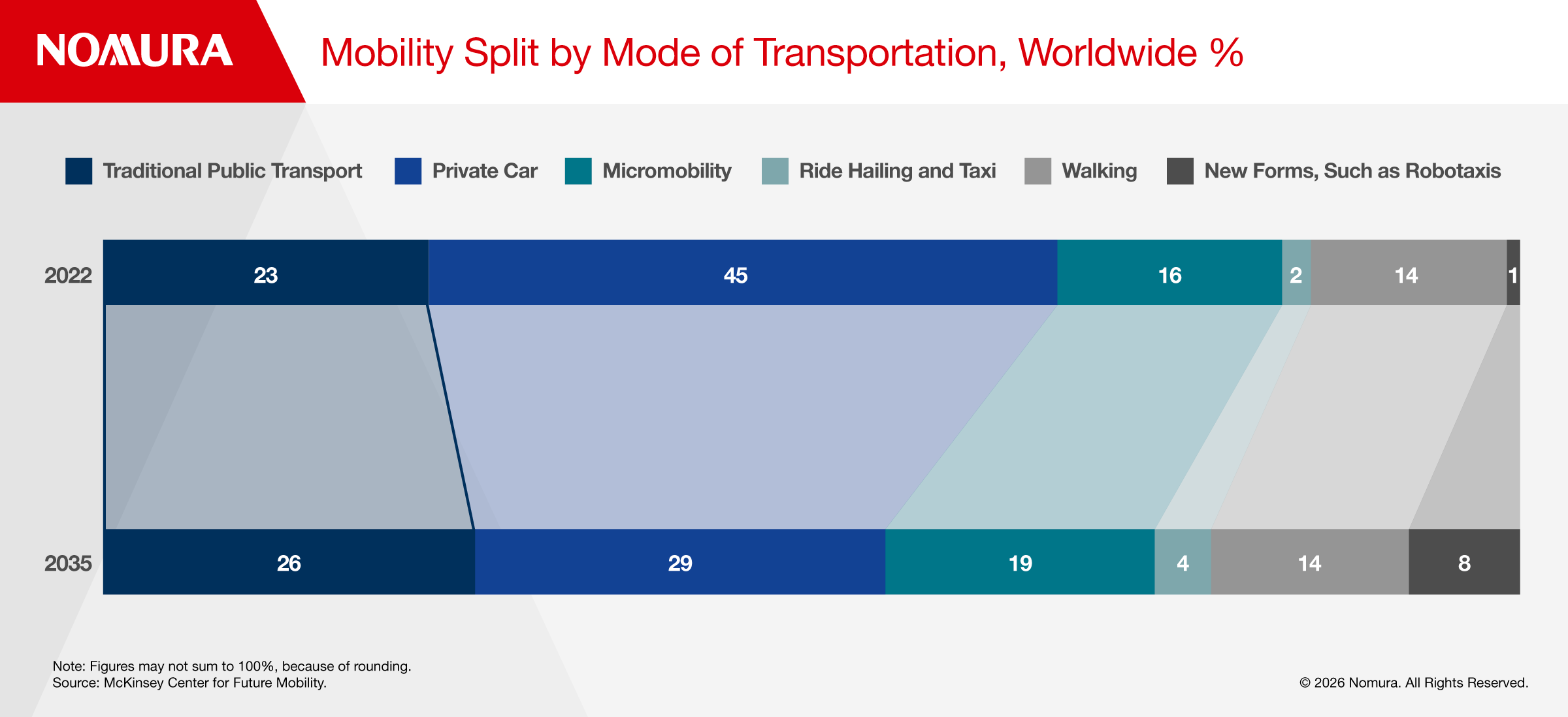
Using electric buses is not as simple as swapping the vehicle for its diesel equivalent. Every route has to be re-evaluated against battery range, and every schedule must account for charging requirements and access to charging infrastructure. Depot infrastructure requires a complete redesign taking into account grid capacity limits, depot logistics and time-of-day charging costs. This planning complexity, modifying critical transportation infrastructure to the economies of each market while ensuring at least the same level of service, makes it an ideal opportunity for AI-powered solutions to accelerate the transition. By leveraging years of operational data from thousands of cities, these systems can optimize the entire transit lifecycle from initial route planning through real-time operations while accounting for the additional constraints that electrification imposes.
The recent repricing of software markets, what has been referred to as the "SaaSpocalypse," has created a sharp divide. Horizontal software as a service (SaaS) - universal tools that are applicable across industries - face potential commoditization as AI agents quickly and cost-effectively replicate their functionality. However, vertical SaaS platforms, which are largely bespoke to a specific sector, and serve mission-critical workflows with proprietary industry-specific data, have retained their valuations better and are now commanding meaningful valuation premiums over horizontal peers.
Vertical AI examples include Veeva, which manages the pharmaceuticals lifecycle, Procore, which operates in the construction sector, and Optibus, which competes in the mass transit sector.
Public transport highlights why certain vertical AI applications have been able to build defensible moats against non-specialized AI-native solutions. Three of these layers of protection have emerged:
Technology depth: Proprietary optimization algorithms developed over years of R&D cannot be easily replicated by startups overnight regardless of how well-funded they are. The complexity in transit planning requires deep technical expertise combined with superior domain knowledge.
Regulatory credibility: Transit agencies do not adopt random tools for mission-critical infrastructure. Enterprise relationships in this sector take years to build trust, require a track record of regulatory compliance, and proof of reliability. Healthcare vertical SaaS shows 2-3% churn versus 10-15% for horizontal customer relationship management software and it is a similar story for transport.
Data compounding: A decade of operational data from 7,000+ cities across 35+ countries creates a flywheel that new entrants cannot replicate as it is proprietary operational intelligence from live transit systems.
The most sophisticated implementations deploy specialized AI agents for each role in the transit operations lifecycle: planning agents for route design, scheduling agents for timetabling, operations agents for day-to-day execution, and control agents for real-time adjustments. This mirrors successful vertical SaaS strategies in other industries - deep knowledge of every job role and constructing purpose-built tools for each.
This approach delivers measurable ROI across multiple dimensions. Operational efficiency improves through cost savings, resource optimization, faster planning cycles, and error reduction. Service quality increases via better on-time performance and schedule adherence, driving ridership growth. Compliance and HR challenges ease through automated regulatory adherence and improved driver recruitment and retention.
For investors evaluating AI opportunities, the public transport modernization story offers several lessons. First, the largest returns may come not from horizontal AI tools but from vertical applications in traditional industries with trillion-dollar addressable markets. Second, complexity creates a defensive moat. Regulation and government contracts act as barriers to entry. Third, sustainability mandates like electric vehicle transitions can create catalysts that force technology adoption in previously resistant sectors.
The vertical SaaS companies succeeding in transit and similar industries share common characteristics: they are mission-critical platforms upon which entire industries operate, they maintain gross revenue retention around 92% with net revenue retention exceeding 112%, and they require half the go-to-market spend per revenue dollar compared to horizontal peers.
As AI continues to reshape software markets, the distinction between defensible and commoditized applications will only sharpen. Public transport's modernization journey from pen and paper to AI-powered optimization platforms demonstrates how long-lasting value can be created.
For more information on this topic, please contact Amos Haggiag or Duncan Williams
Global Co-Head, Nomura Greentech
CEO, Optibus
This content has been prepared by Nomura solely for information purposes, and is not an offer to buy or sell or provide (as the case may be) or a solicitation of an offer to buy or sell or enter into any agreement with respect to any security, product, service (including but not limited to investment advisory services) or investment. The opinions expressed in the content do not constitute investment advice and independent advice should be sought where appropriate.The content contains general information only and does not take into account the individual objectives, financial situation or needs of a person. All information, opinions and estimates expressed in the content are current as of the date of publication, are subject to change without notice, and may become outdated over time. To the extent that any materials or investment services on or referred to in the content are construed to be regulated activities under the local laws of any jurisdiction and are made available to persons resident in such jurisdiction, they shall only be made available through appropriately licenced Nomura entities in that jurisdiction or otherwise through Nomura entities that are exempt from applicable licensing and regulatory requirements in that jurisdiction. For more information please go to https://www.nomuraholdings.com/policy/terms.html.