
Japan in focus | 4 min read | July 2026
The Great Unwind: How Cross-Shareholdings are Reshaping Japan M&A
Tokyo Stock Exchange reforms are providing rare opportunities for domestic and foreign buyers of Japanese companies
Japan in focus | 4 min read | July 2026
Tokyo Stock Exchange reforms are providing rare opportunities for domestic and foreign buyers of Japanese companies

Head of Japan M&A

Co-Head of Investment Banking, EMEA
Japan's corporate landscape is undergoing a profound transformation, driven by a decades-old practice that is finally unravelling. Cross-shareholdings, the web of reciprocal equity stakes that once symbolized corporate loyalty and stability, are being dismantled, unleashing a wave of deal-making activity that is reshaping the nation's business ecosystem.
Japan-related M&A reached JPY 51 trillion ($314 billion) in 2025, climbing 112% from a year earlier, according to LSEG data.
For generations, Japanese companies held shares in banks, insurance companies, suppliers, and clients as a gesture of mutual commitment and loyalty. At its peak in the 1990s, cross-shareholdings accounted for nearly half of all listed equity in Japan. These arrangements served as defensive moats against hostile takeovers and cemented long-term business relationships. However, what once provided stability has increasingly become a strategic liability as new rules demand capital efficiency and shareholder returns.
“The sentiment in corporate Japan has become very dynamic,” says Daisuke Miyazaki, Co-Head of Investment Banking for EMEA. “It’s like the US in the 1980s where companies started considering the cost of capital and adopting more transparent processes to unlock shareholder value.”
The big unwind started a decade ago with the introduction of Japan’s Stewardship and Corporate Governance codes, which encouraged greater board transparency, and a more constructive dialogue between investors and companies.
In 2022, the Tokyo Stock Exchange restructured its market into three tiers: Prime, Standard, and Growth. It established stricter listing requirements and requested that all listed companies, especially those with a Price-to-Book (PBR) ratio below 1.0, take concrete actions to improve their cost of capital, and market valuations, adding urgency to the movement. Companies trading below book value - a common trait among cross-shareholders - faced pressure to demonstrate improved capital allocation. More than a quarter of Japan’s listed companies are trading at a PBR below 1.0x.
“Japan’s sponsor portfolio has increased in recent years, but remains at a low level compared with the U.S and Europe, highlighting a vast underserved market, positioning Japan as a destination for capital reallocation and value creation,” says Masanori Kobayashi, Head of Japan M&A at Nomura in Tokyo.
Institutional investors and activist shareholders have also grown increasingly vocal about the opportunity cost of these holdings. Capital locked in non-strategic equity stakes generates minimal returns while obscuring true operational performance. Furthermore, as the Japanese economy experiences a resurgence after decades of deflation, the imperative for corporates to deploy capital more productively has become harder to ignore.
“The unwinding of cross-shareholdings is a major driver of deal activity in Japan, both M&A and ECM,” says Kobayashi. “Companies are using the proceeds to diversify into growth sectors.”
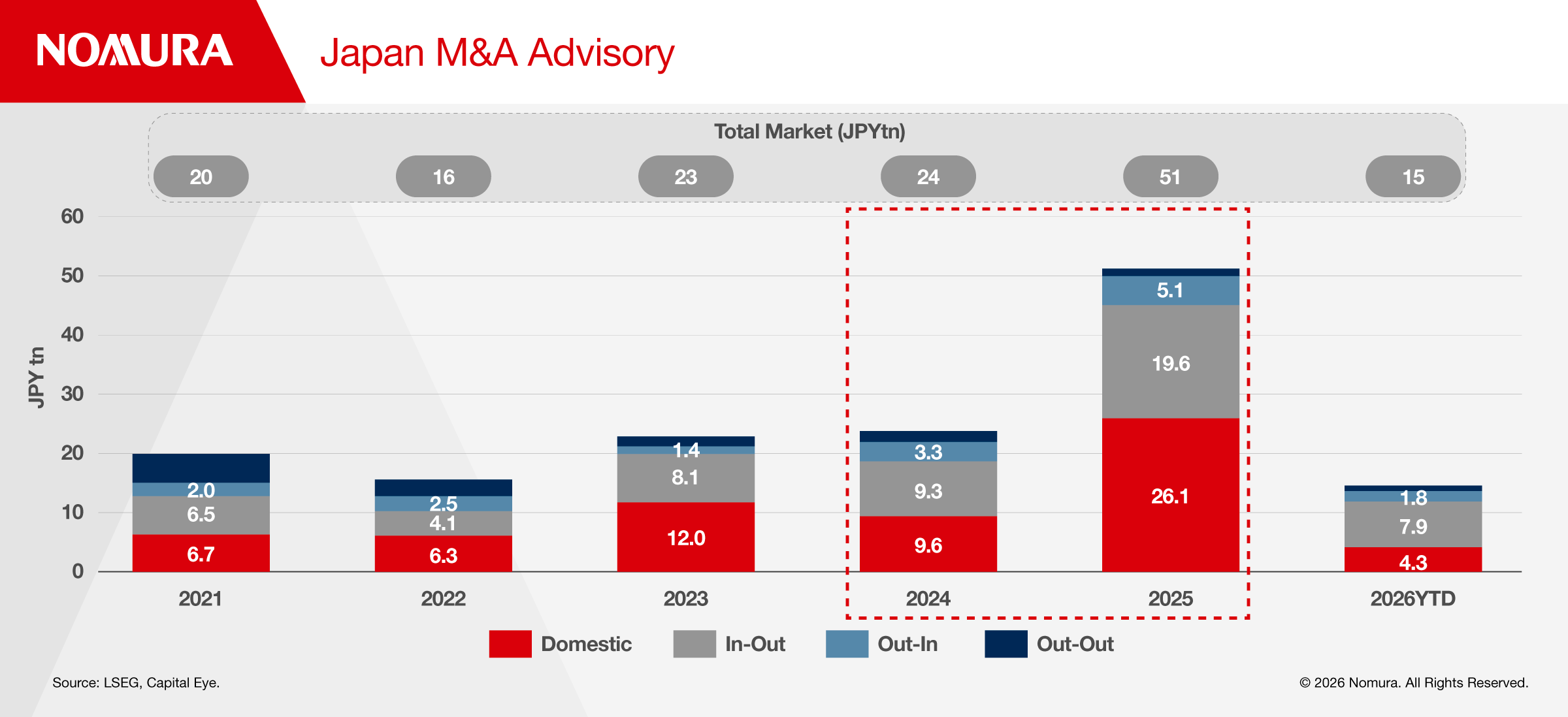
This boom in M&A activity can be seen across multiple fronts. First, the sale of these stakes generates substantial cash reserves that companies are deploying toward strategic acquisitions. Rather than returning all proceeds to shareholders, many firms are using this cash pile to pursue transformative deals that strengthen core businesses.
Second, the process is revealing hidden value and strategic misalignments within corporate groups. As companies reassess their portfolios with fresh eyes, many are identifying non-core assets ripe for divestment. This has fueled a robust market for carve-outs and spin-offs, with buyers ranging from private equity firms to strategic acquirers seeking bolt-on acquisitions.
Third, the unwind is exposing companies to market forces. Without the protective shield of friendly shareholders, firms must demonstrate compelling business cases or risk becoming acquisition targets themselves. This dynamic has emboldened both domestic and international buyers to pursue opportunities that would have been unlikely a decade ago.
“The erosion of cross-shareholdings has stripped away traditional defences such as the ‘just-say-no’ defence, leaving Japan as the second most targeted region for activism after the US,” says Kobayashi. “It is a structural inflection point where the best owner of every asset is being evaluated.”
The just-say-no-defence refers to a board's ability to reject unsolicited or hostile takeover bids by refraining from negotiations, whereas the new era encourages boards to consider shareholder value more carefully.
This institutional shift has catalyzed a boom of foreign acquirers pursuing Japanese assets. A recent example saw Taiwan's Yageo Corporation purchase Japanese sensor maker Shibaura Electronics following a bidding war. Another deal saw Japan’s Yachiyo Industry, an auto parts maker, acquired by Motherson Group, an Indian company, and US private equity firm KKR won a competitive take private tender offer for software company Fuji Soft.
The impact varies significantly across industries. In financial services, major banks and insurers have been among the most aggressive sellers, divesting tens of billions of dollars in cross-held equities. This has freed capital for digital transformation initiatives and strategic partnerships with fintech players.
Cross-shareholdings have plummeted from 50% of total market capitalization in 1990 to just 11% today and over US$ 847bn in value remains entrenched on corporate balance sheets.
“We still have a long way to go to match the 4-5% stakes in corporate America but it won’t go down to zero, smaller strategic stakes will remain” says Miyazaki.
Manufacturing conglomerates, particularly in automotive and electronics, are using proceeds to fund consolidation within their supply chains and invest in emerging technologies. The traditional keiretsu structures are evolving into more focused, strategically aligned partnerships rather than sprawling networks of reciprocal ownership.
The cross-shareholding unwind represents more than a technical reallocation of capital. It signals a fundamental shift in Japanese corporate philosophy. The transition from relationship-based capitalism toward performance-driven governance is creating a more dynamic M&A market overlaying strategic logic to historical ties.
As this transformation continues, we can expect several trends to accelerate: increased foreign participation in Japanese M&A, more assertive activism from institutional investors, and more willingness to consider unsolicited approaches. The winners will be those that proactively reshape their portfolios, deploy capital with discipline, and embrace the creative destruction that defines healthy markets.
“We are seeing a big uptick in inbound calls from international clients who are considering acquiring Japanese companies, says Miyazaki. “Ten years ago, the model was to build incremental stakes and maintain the relationship, hoping it evolves into an acquisition. Now, there is a big opportunity for all domestic and foreign players.”
Japan's deal-making renaissance, powered by the unwind of cross-shareholdings, is not merely a financial engineering exercise, it is the foundation for a more competitive, efficient, and globally integrated corporate sector. The implications will resonate for decades to come.
For more information about this topic please contact Masanori Kobayashi or Daisuke Miyazaki
Head of Japan M&A
Co-Head of Investment Banking, EMEA
This content has been prepared by Nomura solely for information purposes, and is not an offer to buy or sell or provide (as the case may be) or a solicitation of an offer to buy or sell or enter into any agreement with respect to any security, product, service (including but not limited to investment advisory services) or investment. The opinions expressed in the content do not constitute investment advice and independent advice should be sought where appropriate.The content contains general information only and does not take into account the individual objectives, financial situation or needs of a person. All information, opinions and estimates expressed in the content are current as of the date of publication, are subject to change without notice, and may become outdated over time. To the extent that any materials or investment services on or referred to in the content are construed to be regulated activities under the local laws of any jurisdiction and are made available to persons resident in such jurisdiction, they shall only be made available through appropriately licenced Nomura entities in that jurisdiction or otherwise through Nomura entities that are exempt from applicable licensing and regulatory requirements in that jurisdiction. For more information please go to https://www.nomuraholdings.com/policy/terms.html.