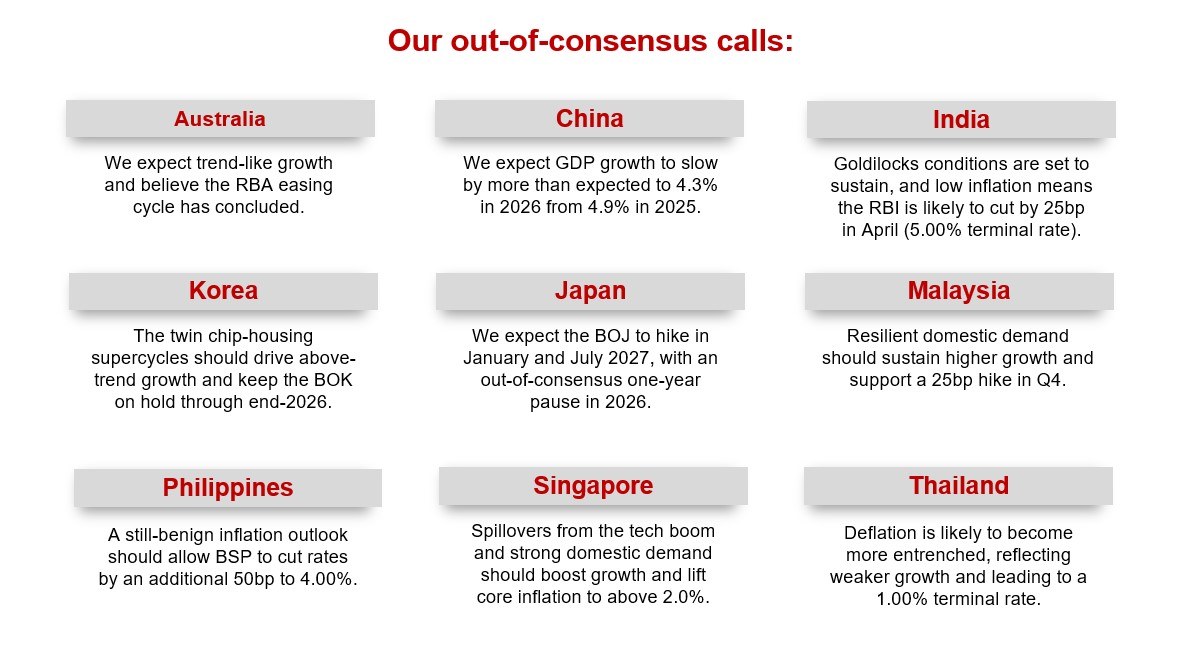
AI continues to be a key theme for 2026, with Asia having positioned itself as a critical player in the AI ecosystem. Nomura economists believe the region is benefitting through multiple channels, including higher exports, investment and consumption. Given Asia’s role as the global manufacturing hub for AI hardware, the export channel is most significant, whereas in the US, the investment channel tends to dominate.
Transmission channels
The boom in US AI capex is translating into increased export orders in Asia for specialty materials, advanced and memory chips, advanced packaging, assembly and testing, semiconductor equipment, and precision machinery. While the intellectual property for AI is largely US-based, much of the physical production takes place in Asia, benefitting the region through the semiconductor value chain.
Rising AI demand is also lifting capex within Asia. Foundries are expanding advanced node and advanced packaging capacity; memory firms are expanding high-end lines, and server manufacturers are investing in new assembly and testing facilities across the region. There is also an increase in third-party data centers in Asia, which is boosting demand for electrical equipment, cooling systems and other infrastructure such as power and land.
In Asia’s tech heavy economies, the valuations of AI-exposed firms have increased significantly, leading to equity wealth effects amid portfolio gains for investors.
Quantifying the gains
It is challenging to quantify how much of Asia’s growth is attributable to AI. As an emerging technology, there is no separate statistical trade/investment classification in official data, which makes it difficult to isolate AI- from broader-tech trends. Still, more granular data can help clarify the gains accruing to Asia.
The World Trade Organization (WTO) has compiled a non-exhaustive list of AI-enabling products and their HS codes, classified into raw materials/processed chemicals, intermediate inputs and equipment. The breakdown shows that Asia dominates in AI-related trade, contributing to nearly two-thirds of global AI trade growth in H1 2025.
Within Asia, the AI trade exposure is concentrated in Northeast and Southeast Asia. AI-enabling goods accounted for over 28% of Korea’s total exports, while Southeast Asian economies have also become deeply integrated into AI supply chains, led by the Philippines, Singapore and Malaysia, as they focus on assembly and testing, data storage, and component and precision manufacturing.
Surge in Asia’s AI-related capex
Data show that Asian tech giants have experienced an investment surge in 2025, while capex is projected by consensus to further rise by 15% in 2026, suggesting momentum is likely to sustain. The higher capex is geared towards building advanced node capacity, high bandwidth memory chips, AI servers, data centers and advanced packaging, among others.
The construction of data centers to meet AI workloads and cloud usage is also boosting investment in the region. Across Asia Pacific, there is currently 3.2GW of data center capacity under construction, 13.3GW in planning, with operational capacity at 12.6GW as of H1 2025. Projections by PwC show that the total APAC operational capacity will more than double to 26.1GW by 2028, with significant capacity additions across China, Japan, Malaysia and India.
Regional benefits are broad-based
The AI-driven recovery pattern has been K-shaped so far, due to its dependence on imported machinery and its high capital intensity. As technology diffusion grows, we will see further benefits, including AI-enabled services, higher productivity in complementary sectors and energy grid investments. That said, a broader adoption of AI technology also raises concerns about automation and potential job losses.
Our analysis also shows that, while Northeast Asian economies like South Korea are a primary beneficiary of the US AI capex boom due to their presence in high value-added manufacturing, Southeast Asian countries including Singapore, Malaysia and Vietnam are also accruing gains through their roles in the AI supply chain, from assembly to data centers. This means Asia is more broadly leveraged to the continuation of the US AI capex boom than a narrow focus on leading tech hubs would suggest.
For more of our Asia outlook, read the full monthly report here.