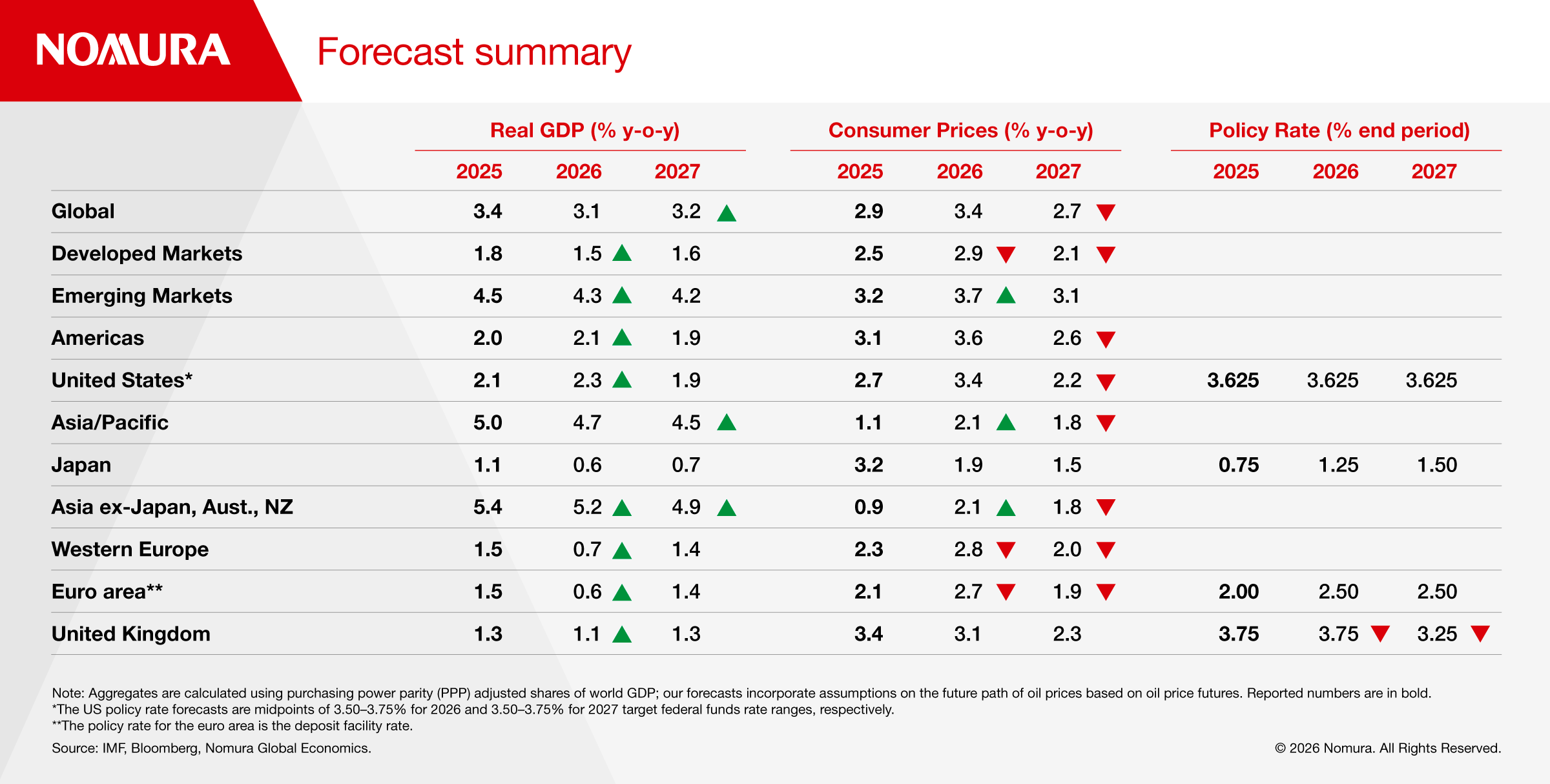
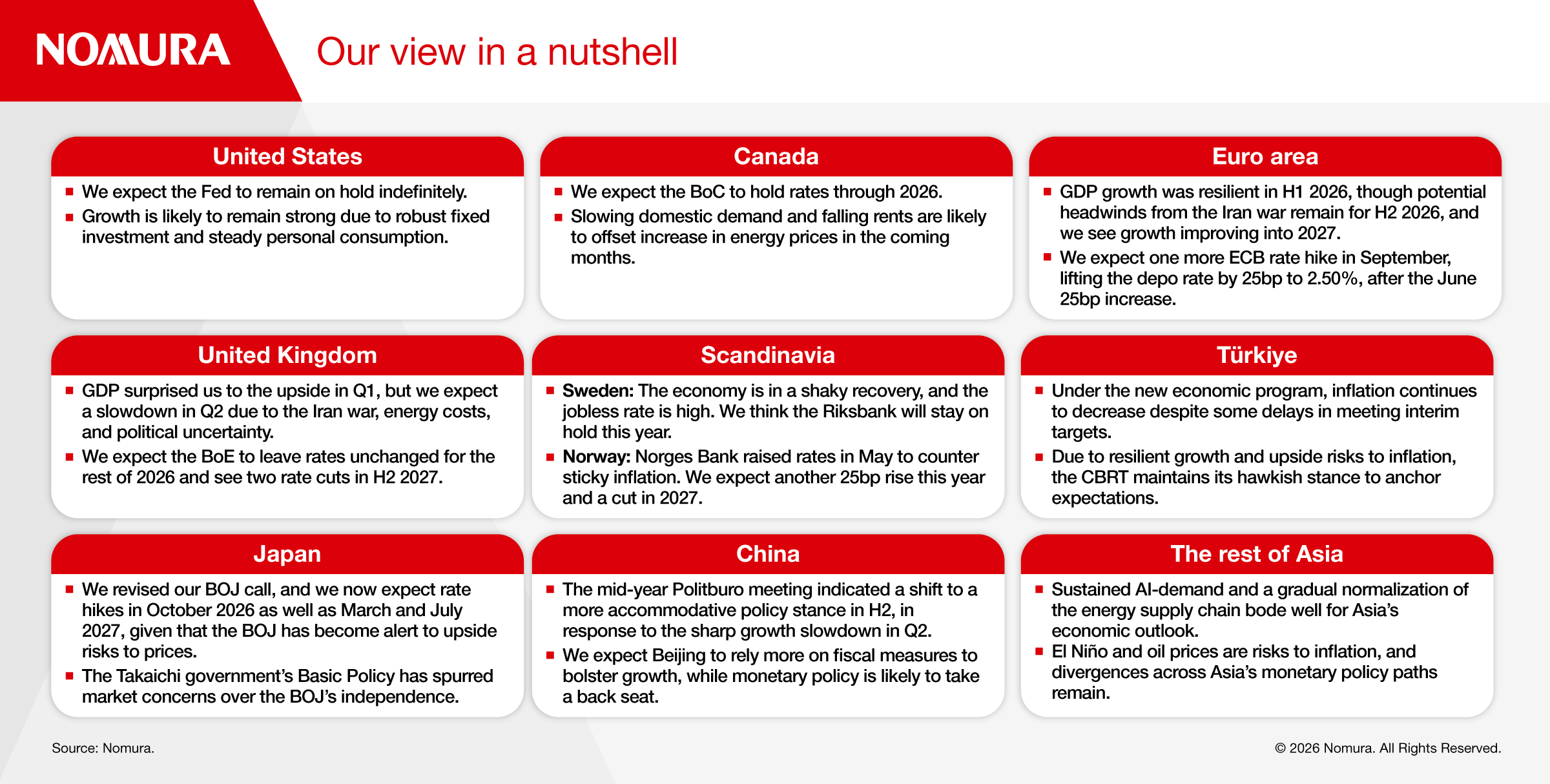
In the first half of 2026, the world economy — supported by the AI transformation and agile government policies — was resilient to the energy price shock, rising inflation and rising bond yields. However, we see several more risks, including US–Iran tensions, El Niño, an AI setback, fiscal fragility, and market reactions to central banks potentially dialing back their forward guidance.
Our outlooks below all face risks from the deteriorating situation in the Middle East.
US: The Fed is likely to remain focused on inflation
We expect continued solid growth, elevated inflation, and the Fed to remain on hold.
Economic activity
Growth has remained robust lately, supported by strong AI investment, fiscal stimulus from the One Big Beautiful Bill Act, and the lagged impact of Fed rate cuts amid accommodative financial conditions. Business investment appears to be broadening beyond the AI sector. Despite higher energy prices stemming from the Iran war, consumption has held up, partly due to higher tax refunds and strong payroll income growth.
Inflation
Core inflation remains well above the Fed’s 2% target, and risks appear skewed to the upside. We forecast Q4 2026 core Personal Consumption Expenditure (PCE) inflation of 3.2% year-on-year with upcoming methodology changes potentially lowering it further. Wage growth is moderating and tariff-related price pressures are abating, but newly emerging AI-related price pressures pose an upside risk. Overall, we believe core PCE inflation has peaked already and will moderate gradually going forward.
Policy
We expect the Fed to remain on hold indefinitely. Fed Chair Kevin Warsh likely remains motivated to avoid tightening. While near-term hikes appear unlikely, the Fed’s hesitance to respond to tentative signs of inflation pressure raises the risk that it may end up behind the curve and need to hike quickly to re-establish credibility. The balance of risks tilt towards tightening.
Euro area: Foiled by oil
Surveys point to an improving growth outlook, but US–Iran hostilities could pause that trend.
Economic activity
The euro area economy was resilient in H1 2026 despite the Iran war, with GDP (excluding Ireland) growing by 0.3% quarter-on-quarter in each quarter. This growth rate is in line with the plausible range of estimates for potential economic growth in the euro area.
While the ZEW, Sentix, and European Commission sentiment and consumer confidence indices have fallen since the war began, outturns for June and July improved. It remains to be seen whether the worsening in hostilities more recently between the US and Iran, and the consequent rise in oil prices, will cause a further downturn in sentiment.
We see euro area growth remaining modest in the near term but improving into 2027, based on our assumptions of an improving geopolitical backdrop, a clearer impact of German fiscal spending, and a continuation of strong Spanish growth.
Inflation
Headline HICP inflation stood at 2.9% year-on-year for July, with core at 2.5%. We expect headline HICP inflation to hover around this level for the remainder of the year while we forecast core to rise by a further 0.1pp, before inflation falls on both measures quickly in the first half of 2027.
Policy
We expect only one more rate hike from the ECB, in September, which would lift the depo rate to 2.50% after the 25bp rate hike in June. However, with the resumption of hostilities in the Middle East and a consequent rise in oil prices, markets see upside risks relative to our view.
Japan: We now expect three more hikes by the BOJ
We expect three more rate hikes, as opposed to two in our previous call, while the relationship with the government is under renewed focus.
Economic activity
While we do expect real GDP to contract in quarter-on-quarter terms in Q3 due to a decline in exports of goods and services (i.e. inbound tourism), as well as a slowing of private consumption, we believe Japan’s economy will remain on a recovery path, with capex functioning as an axis.
Prices
We stick to our view that year-on-year core consumer price index (CPI) inflation will accelerate to reach a peak of over 3% year-on-year in the first quarter of 2027, after which it will come down to around or below 2% in the fourth quarter of 2027, assuming Japan avoids a further depreciation of the yen.
Policy
On July 21, the Takaichi government approved its first “Basic Policy on Economic and Fiscal Management and Reform.” It explicitly states that it will be “very important” to conduct monetary policy so that the economy can become “strong.” This led to a renewed focus on the relationship between the government and the BOJ since markets took it as a possible sign of “fiscal dominance,” undermining the BOJ’s autonomy.
Given our inflation outlook and the BOJ being newly alert to upside risks of inflation, we revised our BOJ call. We now expect three more hikes, in October 2026 and March and July 2027.
Asia ex-Japan: We warn against painting Asia with one brush
In China, the economy is still characterized by weak domestic demand and strong exports. We expect Beijing to step up government bond issuance and fiscal spending in H2 to address weak domestic demand, while the strong exports will limit the scale of incremental fiscal policy measures. The higher prices of oil and chips will weaken terms of trade and suppress China’s net exports. As other major central banks are considering rate hikes amid rising inflationary pressures, we maintain our forecast for no RRR or rate cuts this year.
In the rest of Asia, sustained AI-demand and a gradual normalization of the energy supply chain should bode well for Asia’s economic outlook. Taiwan and South Korea are benefiting most from the chip supercycle, but AI spillovers are also boosting growth in Malaysia and Singapore. We expect Taiwan, Malaysia, and Singapore to outperform consensus expectations, and our outlook for India’s economy is brightening, while we remain more cautious on Indonesia and Thailand.
El Niño and oil prices are likely to determine Asia’s inflation outlook, with the former a risk to food prices. Divergence in growth and inflation outlooks is likely to lead to divergences across Asia’s monetary policy paths remain. We expect policy tightening in Indonesia, Malaysia, the Philippines, Korea, and Taiwan, while rates are likely to be left unchanged in India and Thailand.
To read the full report, click here.