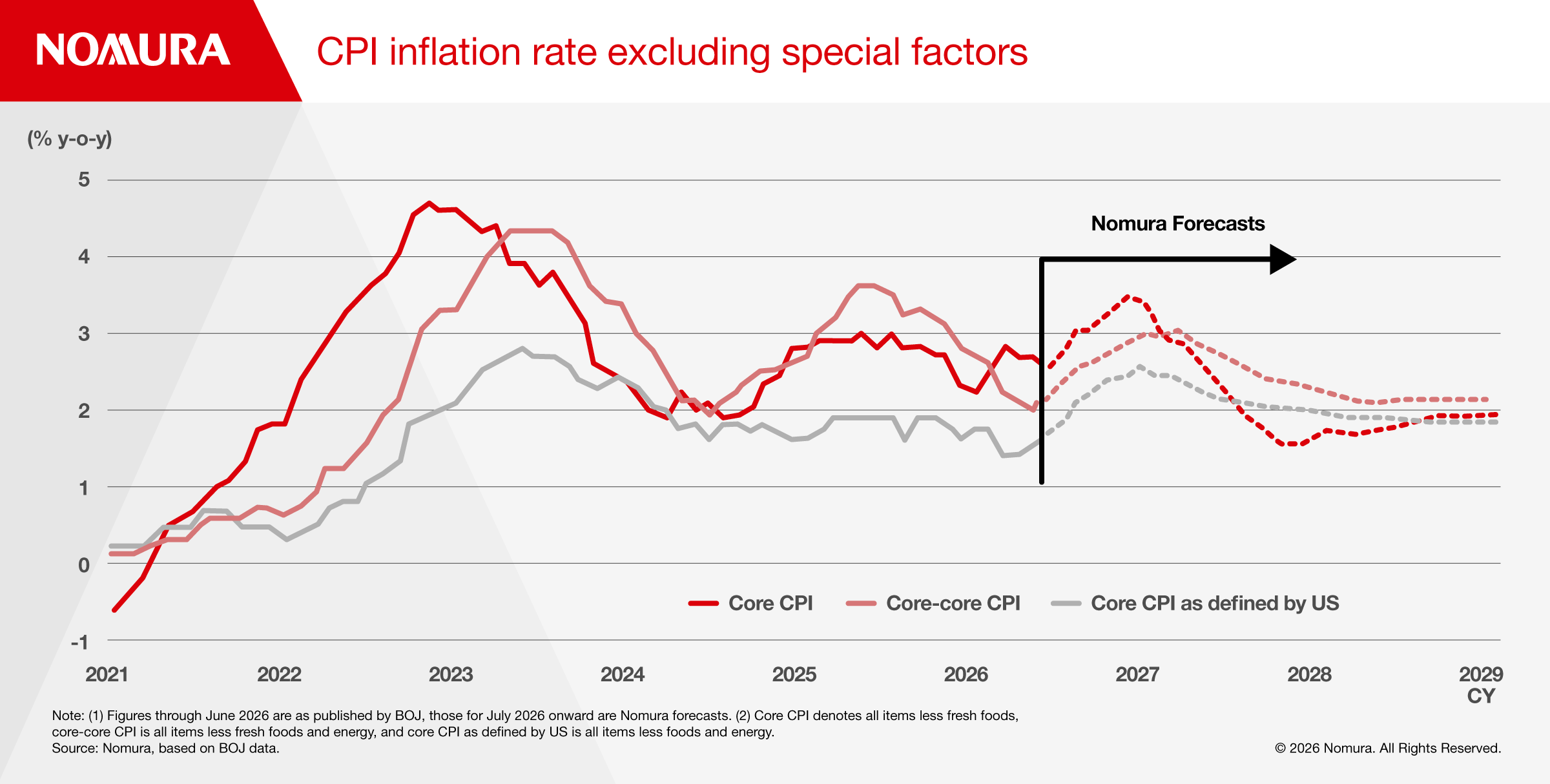
Our outlook for consumer price index (CPI) inflation through March 2029 can be divided into three phases.
The first is accelerating inflation. We expect core CPI to peak at +3.7% year-on-year in the first quarter of 2027, as B2B inflation is passed on to consumers. The second phase sees core CPI inflation slowing from its 2027 Q1 peak to reach approximately 2% by March 2028. The third is stable inflation, with core CPI remaining around 2% year-on-year from April 2028 onwards.
The current inflation picture
Companies have been passing on rising crude oil prices, particularly in B2B operations. The producer price index (PPI) shows that, in July, inflationary pressures eased upstream in the supply chain — including for petroleum, coal, and chemical products — but higher costs continued to be passed on midstream and downstream. We also see localized upward pressure on prices from the global AI/semiconductor boom, particularly for PCs, memory, and copper.
However, the impact on CPI has been limited to date. All-Japan core CPI (all items, excluding fresh food) came in at +1.7% year-on-year in August 2026, remaining below 2% year-on-year, partly because of gasoline subsidies.
Phase 1: Uptick in inflation caused by high crude oil and naphtha prices
The July and August CPI data showed price hikes for some goods such as food and detergent. Company-specific reports also show that many companies have announced price hikes from July or August. We expect the pass-through of higher crude oil and naphtha prices to gradually push up CPI.
However, the resumption of government electricity and gas subsidies has depressed CPI from August–October 2026. Of course, companies will likely continue to pass on cost increases during this period, but we think the headline inflation rate is unlikely to rise substantially until November 2026 at the earliest. We expect core CPI to peak year-on-year in the first quarter of 2027 as companies continue to pass on cost increases.
Phase 2: Decline in inflation caused by lower crude oil prices and consumption tax cuts
If moves to pass on cost increases run their course and crude oil prices start to fall as assumed by the futures curve, we think CPI inflation will begin a year-on-year downtrend by mid-2027 at the latest. We expect energy-related items to exert downward pressure on inflation.
In addition, the government has decided to lower the consumption tax rate for food and beverages from the current 8% to 1% in April 2027. This will apply to around 22% of the overall CPI weighting. If the entire tax cut is deducted from selling prices, we estimate that this will dent core CPI inflation by around 1.3ppt.
However, we do not expect the entire tax cut to be deducted from selling prices, and some of it will be absorbed by price hikes. But we think it is reasonable to assume that a considerable proportion of the tax cut will feed its way through to lower selling prices.
Phase 3: Return to 2% inflation
We expect inflation to pick up again from the start of FY2028 as the dent to inflation from consumption tax cuts and lower crude oil prices runs its course. Barring some kind of external shock, we expect CPI inflation to return to its underlying inflation trend at that point.
Risks related to prices
Underlying inflation could rise above the current level due to cost-push inflation caused by higher crude oil prices and yen depreciation. Longer-term inflation expectations of various economic agents — including households, companies, and experts — rose sharply in Apr–Jun 2026. The BOJ’s composite expected inflation rate also reached nearly 2% in the same period.
However, despite this rise in longer-term inflation expectations, domestically generated inflation has been lackluster recently. We think wages will be key to gauging whether changes in forecasts will materialize. We expect spring 2027 wage hikes to be broadly in line with FY2026, but if they are much higher, inflation initially driven by external factors could become entrenched.
Even if underlying inflation does not rise, we see a risk that the yen will continue to weaken and CPI inflation will remain high. The BOJ is currently raising interest rates to adjust the degree of monetary easing and bring rates to around the neutral rate. However, the interest rate level that satisfies the FX market and stops yen depreciation is not necessarily the same as the neutral rate for domestic economic activity.
To read the full report, click here.