
Geopolitics | 6 min read September 2026
Annual Outlook | 4 min read | September 2026
Japan’s Long Recovery Faces New Tests
Capex will likely form the basis of Japan’s economic recovery through FY2028
Annual Outlook | 4 min read | September 2026
Capex will likely form the basis of Japan’s economic recovery through FY2028

Chief Economist, Japan

Japan Economist

Japan Economist

Japan Economist
As of July 2026, Japan’s current economic recovery had lasted for 74 months. This has surpassed the 73 months of what is called the Izanami Boom — a period of economic growth from February 2002 to February 2008 — which had, up to that point, been the longest recovery since World War 2. However, the length of an economic recovery bears no particular relation to its strength. Instead, the pace of the recovery is key to assessing the economy.
Despite the impact of heightened tensions in the Middle East and the Kumamoto earthquake, we expect the Japanese economy to recover at a pace that is in line with or above its potential growth rate from the fourth quarter of 2026 onwards. We now forecast real GDP growth of +1% year-on-year for FY2026, +0.7% for FY2027, and +0.7% for FY2028. This is not a marked change from our previous forecasts in June.
Although we have cut our FY2027 outlook for real public investment, we maintain our view that capex will form the basis of the economic recovery through FY2028.
However, risks and uncertainty remain. First, we expect B2B inflation upstream, stemming from the situation in the Middle East, to be transmitted downstream through Jan–Mar 2027, manifesting in CPI inflation. This risks dampening household spending by more than expected.
Second, the Takaichi Cabinet plans to lower the consumption tax rate on food and beverages from 8% to 1% for two years from April 2027, and we expect consumer spending to rise in the second quarter of 2027. However, there is uncertainty about how consumption tax cuts will affect the economy and the extent to which an increase in household purchasing power would stimulate fresh spending, if at all.
Third, the US has been increasing crude oil exports to Japan since June in place of oil from the Middle East, but we see risks to the sustainability of crude oil procurement from the US given the limited scope for the US to increase its own crude oil output.
Japan’s real imports of petroleum were around 30% of the 2025 average in April 2026, but they recovered to over 100% of the 2025 average in July. Crude oil imports increased not only from the UAE and Saudi Arabia, Japan’s main sources, but also from non-Middle East countries such as the US, Russia, and Malaysia.
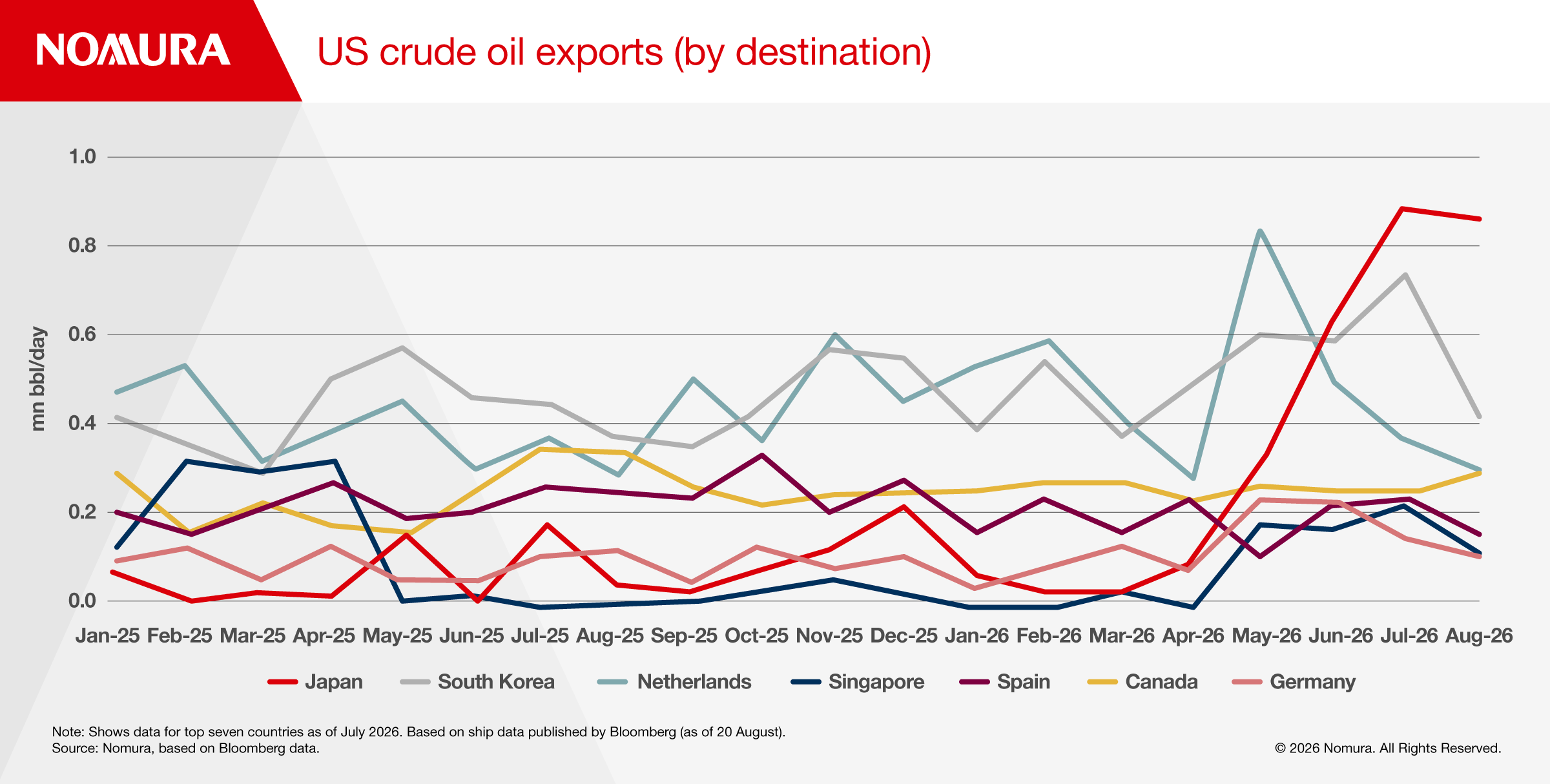
According to shipping data, crude oil shipments from the US to Japan have risen sharply since May 2026 (Figure 1). Japan was the biggest export destination for US crude oil in June and July. Whether oil imports from the US remain stable will hinge on releases from the US strategic petroleum reserve, production volumes, and inventory drawdowns.
Accordingly, we think US crude oil supply could start declining around the beginning of 2027, assuming no additional US reserve releases, which could affect exports to Japan. In addition, if Japan’s crude oil imports from the US remain at their current level over the longer term — and if other countries also maintain current import volumes from that source — US oil production will have to, at the very least, remain at its current level.
If the situation in the Middle East were to become protracted and oil procurement from the US were to slow, Japan would see the simultaneous tightening of two sources of crude oil.
Risks and opportunities lie ahead for the Japanese economy. AI investment is increasing globally, intensifying inflationary pressures through concentrated demand for semiconductors, data centers, and related materials, particularly in the US and China.
Stronger AI demand is likely to increase exports of Japanese semiconductor-related products and capex, thereby boosting production. It will also lead to improvements in Japan’s terms of trade; export prices of semiconductor-related products have been rising more rapidly than import prices. This means that the environment is conducive for Japanese companies to increase their incomes through trade.
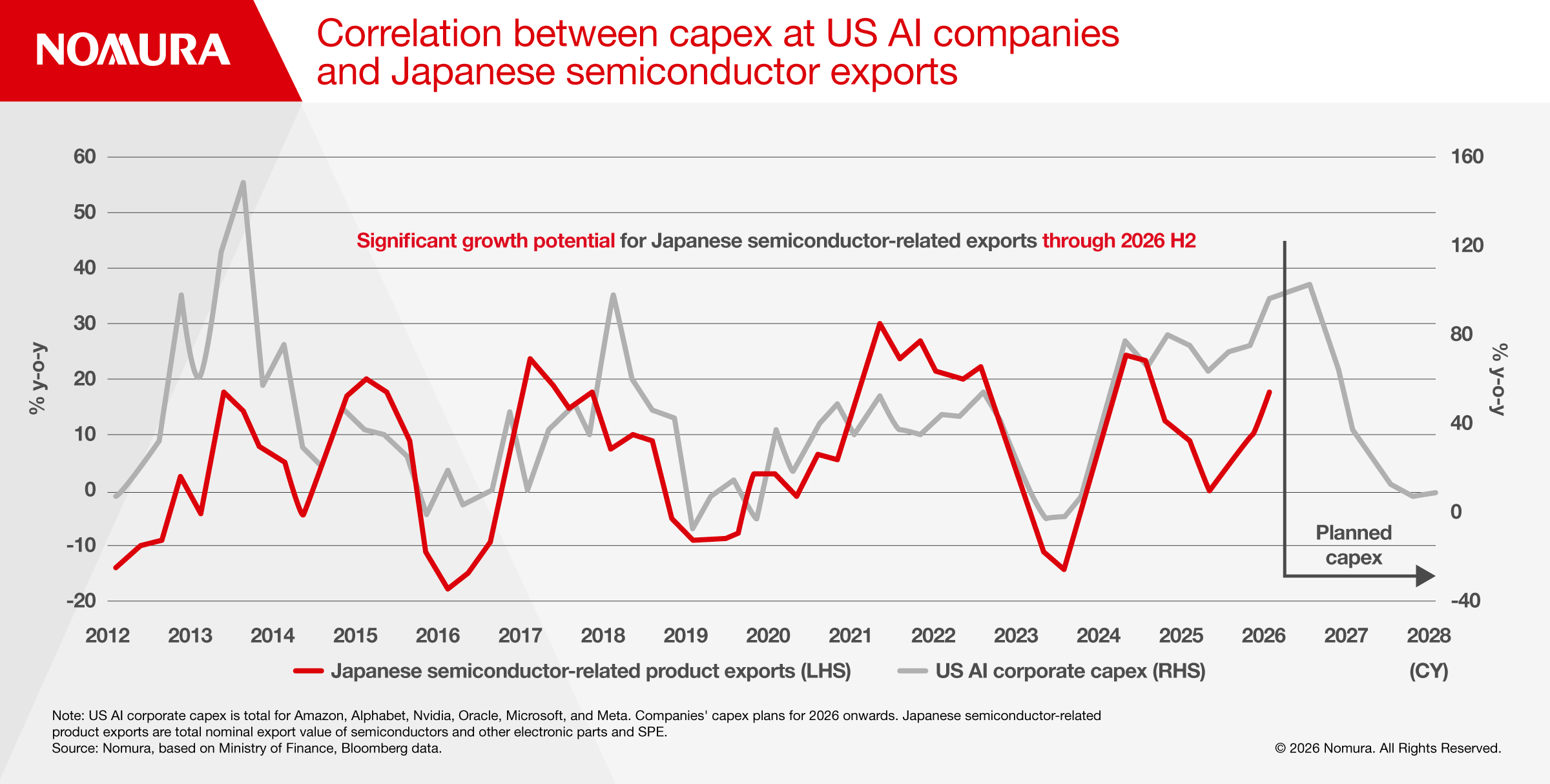
The capex plans of the six US hyperscalers — Amazon, Alphabet, Nvidia, Oracle, Microsoft, and Meta — point to solid AI-related investment going forward, and there is a strong correlation between their plans and Japan’s semiconductor-related product exports (Figure 2). If their capex plans are implemented, Japan’s real GDP could be boosted by around 0.1–0.2% in 2026. Depending on the sustainability of the AI boom, it could boost the economy from 2027 onwards.
With semiconductor demand likely to rise because of the AI boom, what kind of share of the global market can Japan secure?
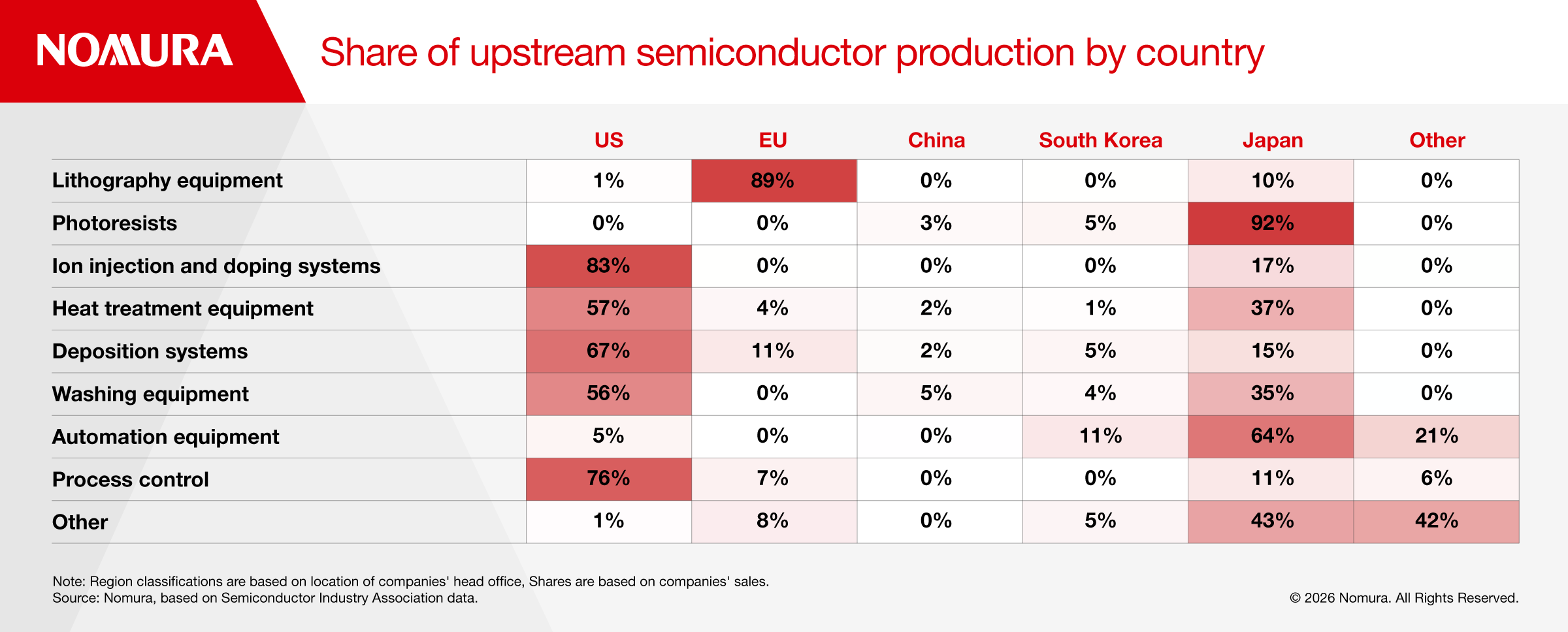
Although Japan now accounts for less than 10% of global semiconductor exports, compared with around 40% in the 1990s, Japanese companies still have a strong presence in upstream areas such as silicon wafers, photoresists, and cleaning agents, as well as in production and testing equipment (Figure 3). It will be key for Japan to maintain and strengthen its competitiveness in these upstream areas.
We lowered our real GDP growth forecast for FY2027 to reflect a greater reduction in public investment than we had previously envisioned. This was triggered by reports that the government is considering postponing a second budget for FY2026 this autumn. If this is true, public investment related to building national resilience is bound to decline in FY2027.
Meanwhile, weak private-sector capex remains an additional risk to the outlook. Real capex has lacked obvious momentum for five quarters now, and further deterioration could result in downward revisions not only to our capex forecast but also to our broader forecast for the economy.
To read the full report, click here.
Chief Economist, Japan
Japan Economist
Japan Economist
Japan Economist
This content has been prepared by Nomura solely for information purposes, and is not an offer to buy or sell or provide (as the case may be) or a solicitation of an offer to buy or sell or enter into any agreement with respect to any security, product, service (including but not limited to investment advisory services) or investment. The opinions expressed in the content do not constitute investment advice and independent advice should be sought where appropriate.The content contains general information only and does not take into account the individual objectives, financial situation or needs of a person. All information, opinions and estimates expressed in the content are current as of the date of publication, are subject to change without notice, and may become outdated over time. To the extent that any materials or investment services on or referred to in the content are construed to be regulated activities under the local laws of any jurisdiction and are made available to persons resident in such jurisdiction, they shall only be made available through appropriately licenced Nomura entities in that jurisdiction or otherwise through Nomura entities that are exempt from applicable licensing and regulatory requirements in that jurisdiction. For more information please go to https://www.nomuraholdings.com/policy/terms.html.

Jump to all insights on Annual Outlook
Geopolitics | 6 min read September 2026
Annual Outlook | 5 min read August 2026
Japan in focus | 4 min read July 2026