US public debt at 100% of GDP is near historical highs, fiscal and current account deficits remain large, the Federal Reserve has missed its inflation target for five straight years and there appears to be a loss of international trust in US fiscal, trade and foreign policy. Yet global investors aren’t exhibiting any signs of a meaningful retreat from USD assets.
So, what’s driving the demand? The answer could be artificial intelligence (AI). But this dependence has created a precarious equilibrium; US exceptionalism may now rely heavily on a single narrative.
The "No Alternative" myth: Why TINA is no longer ironclad
For decades, the "There Is No Alternative" (TINA) thesis justified America’s exorbitant privilege. Even during crises such as the Global Financial Crisis (GFC) and the pandemic, the dollar strengthened, not so much because foreign investors doubled down on US risk assets, but because US investors repatriated foreign assets aggressively.
Today, the landscape has shifted further:
Global capital concentration in US assets has reached extreme levels, with foreign ownership quadrupling since 2008 to represent 80% of the world’s net creditor nations' foreign holdings.
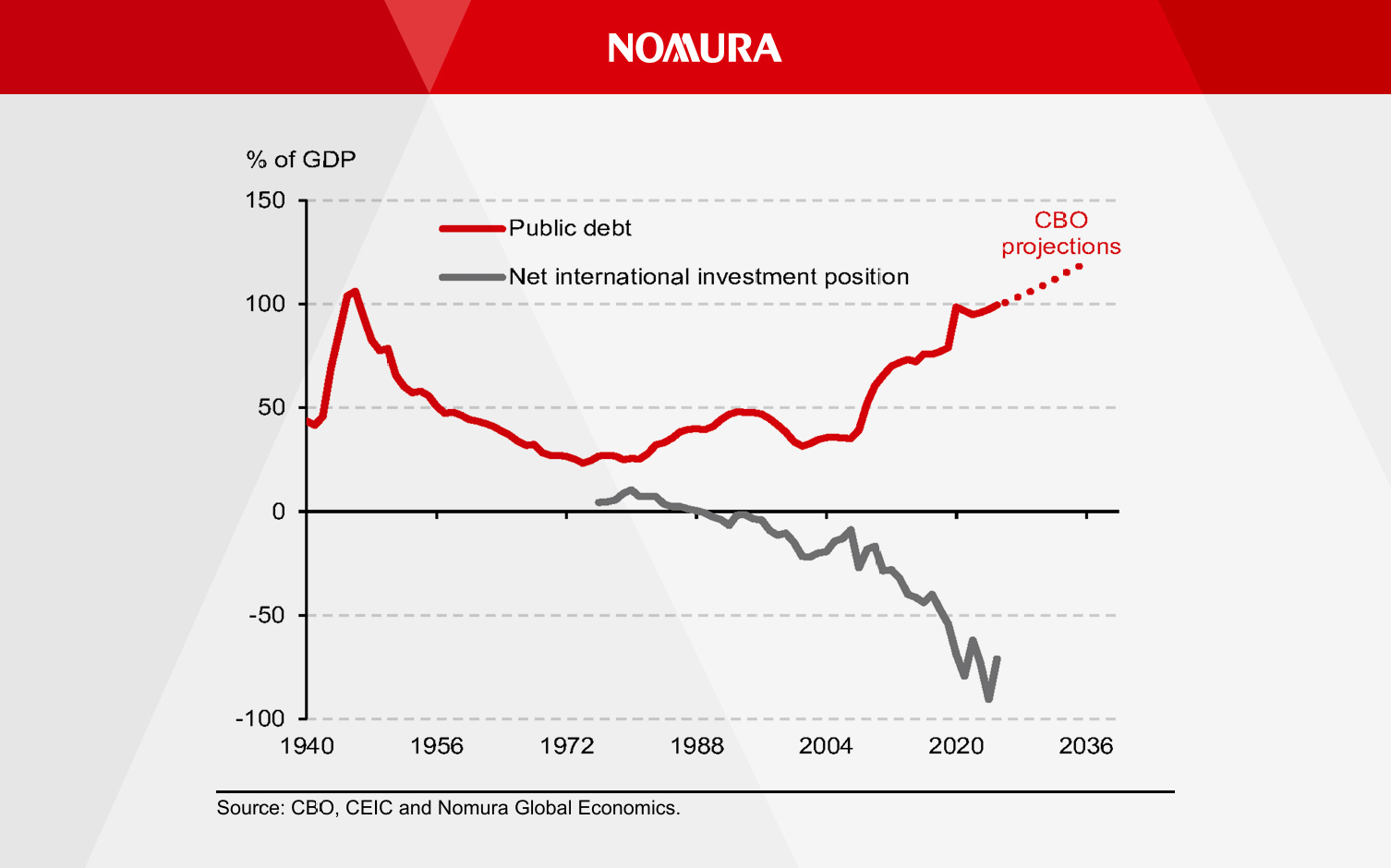
Because of rising UST yields and America’s status as the world’s largest net international debtor, the component of the current account called US net primary income surplus – made up of net profits, dividends and interest – recently flipped into deficit. This could start to weigh on the current account deficit, just as the government’s net interest payments have swelled the fiscal deficit. This dynamic has the potential to threaten the dollar's "exorbitant privilege" if yields and liabilities continue climbing.
US public debt and net international investment position
The AI boom: A double-edged sword
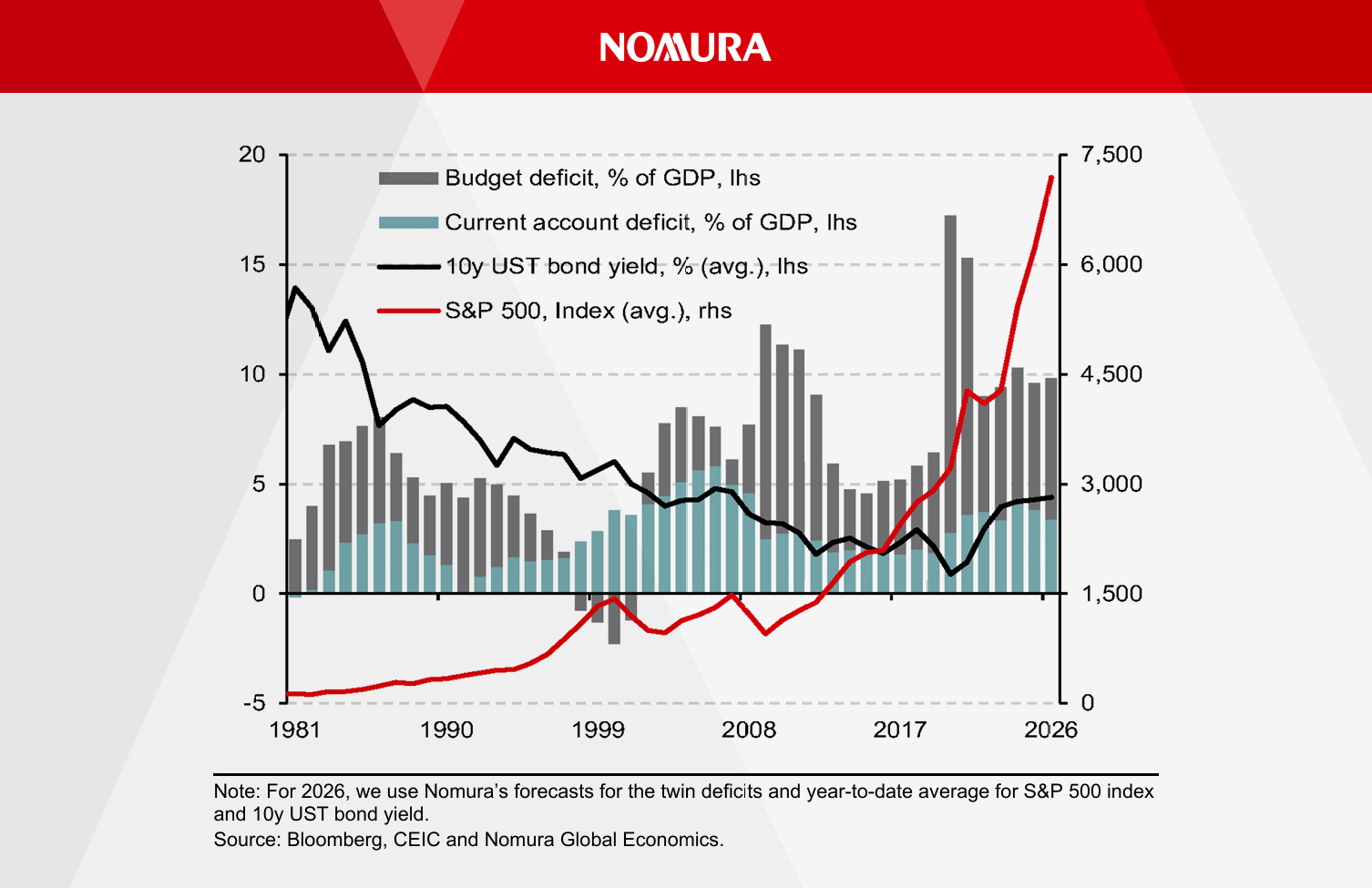
For now, the AI revolution has become the de facto justification for TINA:
- AI-driven stocks have generated extraordinary valuation gains and global investors have poured capital into US markets to gain exposure to the theme.
- Net capital inflows and equity market appreciation have pushed foreign holdings of US assets to unprecedented levels.
- US net international liabilities now account for roughly 80% of the combined net foreign assets held by the world's creditor nations.
The AI boom conceals a rising US risk premium
But what if the AI narrative falters?
The sheer concentration of global capital in USD assets has fundamentally altered the US dollar’s sensitivity to market shifts, making the "No Alternative" (TINA) thesis more fragile than investors assume, according to our analysis.
Today, it may only take moderate percentage declines in foreign-owned US assets to outweigh declines in US-owned foreign assets, reducing NIIP liabilities and weakening the dollar, according to our simulations. This wasn’t a scenario in past crises.
Unlike previous episodes, when US investor repatriation acted as a stabilizing force, the unprecedented concentration of global savings in USD assets means even a modest correction could trigger outsized outflows, exposing the dollar to sentiment-driven volatility in ways that challenge its long-standing dominance.
Geopolitical trust: The silent erosion
Adding another layer of complexity, international alignment with the US has weakened over time. As part of our analysis, we developed a measure of US allies and foes based on voting patterns across more than 5,000 UN General Assembly resolutions from 1965 to 2025.
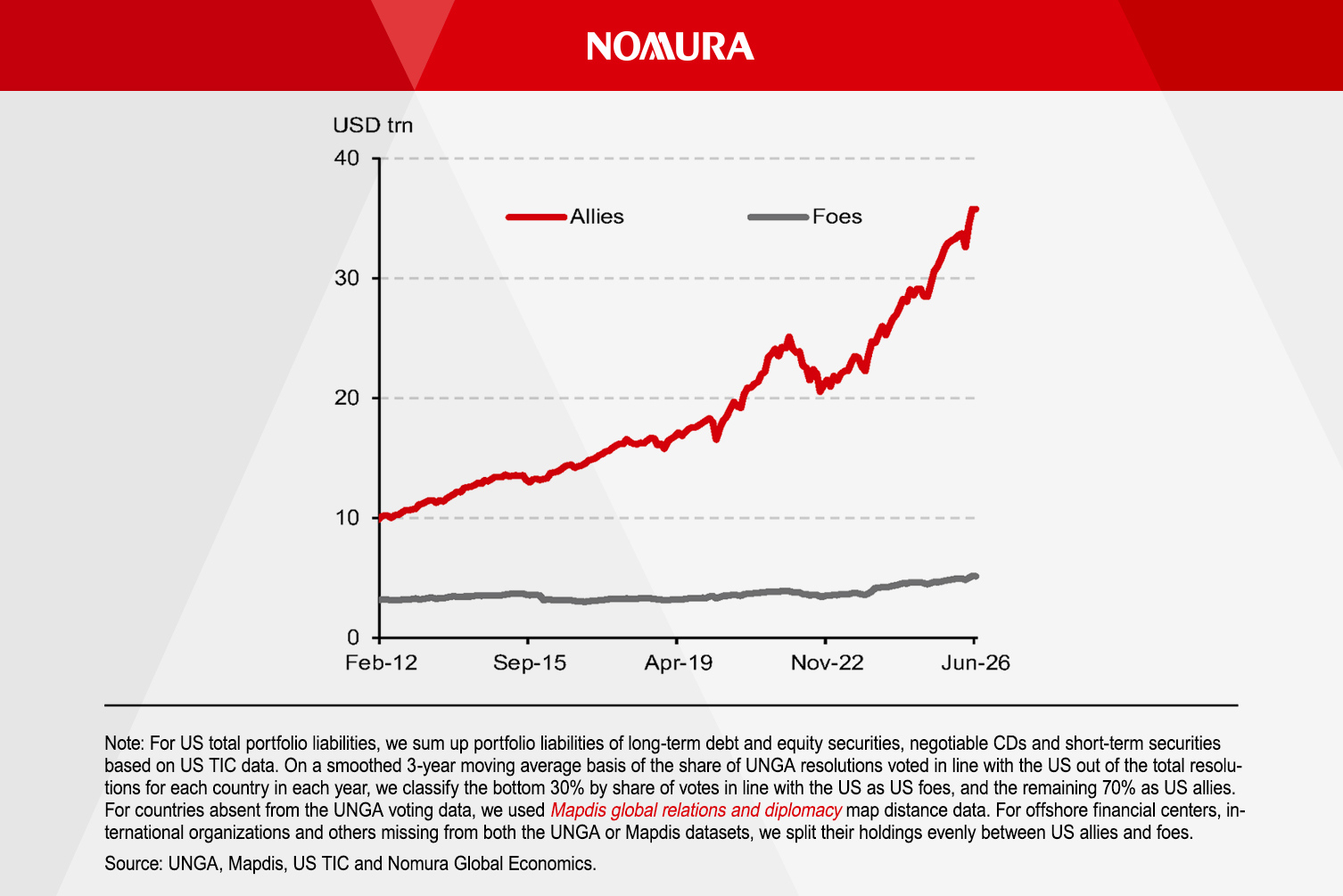
We found voting alignment with the US has declined over time, with the share of countries voting with the US dropping to less than 10% in 2025, possibly reflecting a weakening of trust in US policies. That may trigger concerns, because allies have typically backed US assets. Between 2012 and 2026, our analysis shows that the USD portfolio holdings of the US allies’ group have grown at more than four times the pace of the US foes’ group.
US portfolio liabilities by US allies versus foes
The core question: What if an AI setback unmasks America’s risk premium?
If the dollar’s strength is becoming more anchored to the AI-driven growth story, a narrative shift could expose vulnerabilities:
- A rising US risk premium: Investors may no longer overlook the risks of an unprecedented concentration of global capital in USD assets.
- A feedback loop of fragility: Rising UST yields could exacerbate fiscal and current account deficits, piling on to US government debt and foreign liabilities, further weakening the dollar’s appeal.
The AI boom has masked a structural shift: The US is now more dependent on foreign capital than ever, yet its ability to generate net primary income on its external account has collapsed, while government net interest payments are now larger than defense outlays. The Treasury’s response to rising UST yields in doubling its buyback program for long-duration bonds is a short-term fix, not a sustainable solution.
If AI momentum stalls, the assumption of "No Alternative" to USD assets could weaken.
What happens if AI falters?
An AI setback could trigger:
- A US equity correction, amplified by extreme foreign investor exposure and leverage in the AI ecosystem.
- A global risk-off event, with the Fed cutting rates and US investors rotating into Treasurys—pushing UST yields down but accelerating capital outflows.
- Dollar depreciation, as foreign holders of USD assets reassess their extreme exposure.
The most intriguing question: what will foreign holders of US assets do in the event of an AI setback? The sheer scale of USD foreign liabilities means even a moderate correction could have outsized consequences.
Conclusion: Debunking the assumed robustness of TINA
The resilience of the US dollar potentially now hinges heavily on the AI investment boom continuing unabated. If AI delivers, the dollar’s strength could sustain.
If AI falters, America’s economic vulnerabilities will likely become more apparent, leading foreign investors to reassess the extremely high concentration risk in USD assets.
For our full analysis, read here.