For most of the past four decades, the semiconductor cycle largely tracked the global economy, with demand rising in booms and falling in busts. Today, that relationship is changing.
Semiconductor supply shortages are now increasingly driving business cycles including exports, income and trade surplus across global economies, particularly in major chip manufacturing hubs such as Korea, as the industry faces its worst supply crunch in decades.
As AI-driven spending fuels the largest technology investment boom since the late 1990s, semiconductor availability is becoming an increasingly binding constraint on how much planned investment can be executed, making chip supply a key determinant of growth and trade.
The semiconductor cycle has become a source of macroeconomic momentum in its own. Our newly introduced Nomura Chip Shortage Index (Nomura CSI) suggests the current shortage-driven upswing and elevated chip prices can persist. Together with our thematic research and monthly updates, Nomura CSI can help shed light on the evolving business cycle in the AI era.
The AI boom is creating an unprecedented chip shortage, which is reshaping the dynamics of the business cycle and policy reaction.
Is semiconductor supply becoming the new constraint on global growth?
AI demand is becoming more persistent: Unlike past cycles tied to consumer electronics upgrades, AI infrastructure investment is being driven by multi-year spending plans, making demand less sensitive to chip prices.
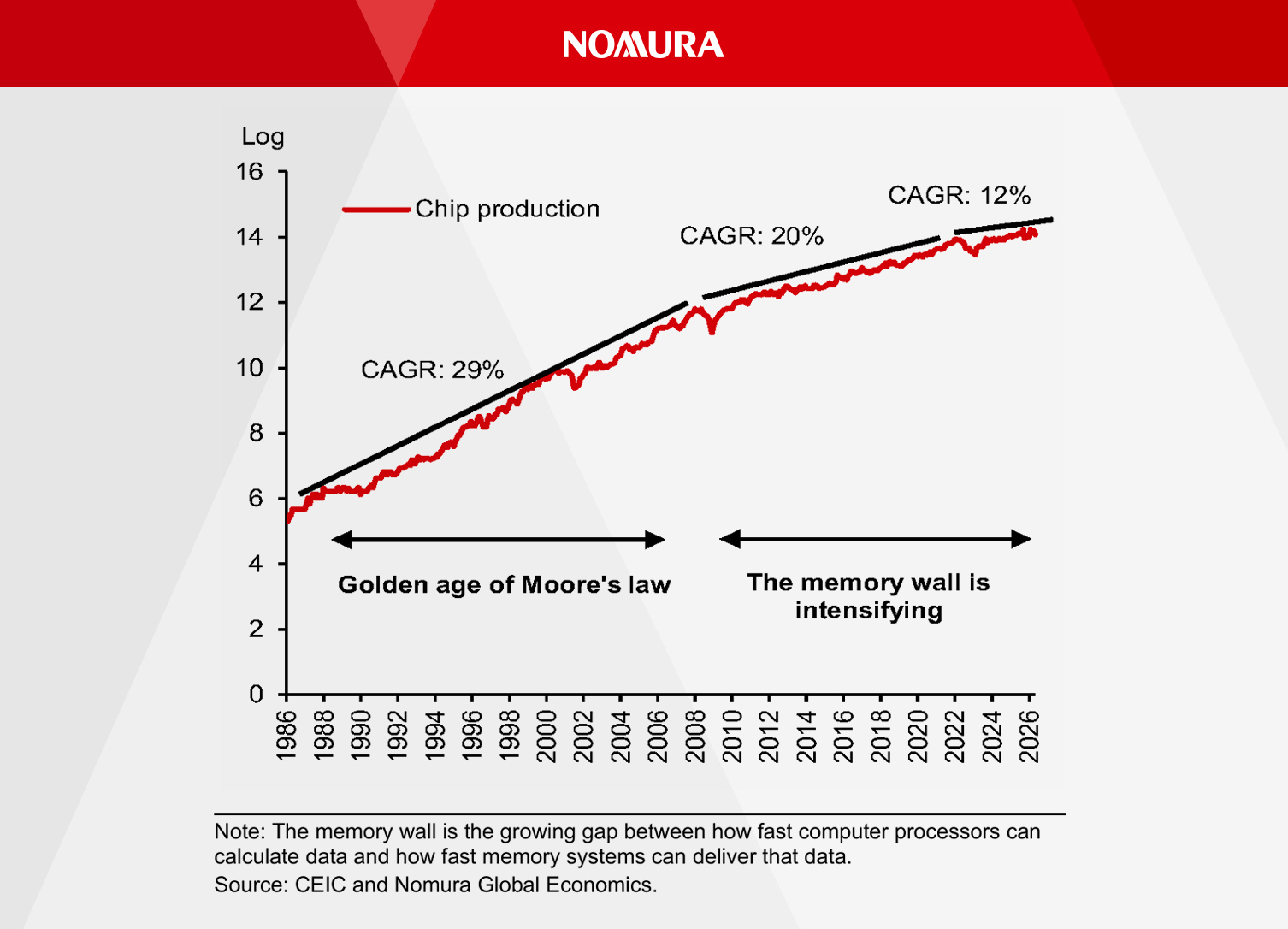
Supply is no longer expanding effortlessly: The benefits of Moore’s Law are fading as advances in chip miniaturization become harder and more costly, slowing growth in semiconductor supply.
Bottlenecks are emerging where demand is strongest: AI-driven demand is concentrated in advanced chips and memory, while new capacity takes years to build, causing supply to adjust slowly and creating persistent shortages.
From Moore's Law to the memory wall
A structural shortage does not prevent cycles
A persistent bottleneck can lift prices and amplify the cycle, but does not eliminate the cycle. As past technology booms have shown, high prices eventually spur new capacity, often leading to oversupply and correction.
The physics of the bottleneck results in a higher average price level and larger cyclical swings. For investors and policymakers, distinguishing the structural trend from the cyclical phase is critical.
As a result, chip shortage dynamics define business cycles. This is where the economics of supply takes over from the physics:
These two forces together are becoming more prevalent in AI capex cycles and creating new business cycles in the AI era, underscoring the need for a systematic way to track semiconductor scarcity and the balance between chip supply and demand over time.
Introducing the Nomura Chip Shortage Index
Shortages leave a clear footprint in the data: export values diverge from export volumes, production diverges from shipments, inventories fall as orders rise and announced capital spending runs ahead of actual spending. While each indicator is noisy on its own, their combined signals reveal the underlying imbalance, which the Nomura CSI aims to capture.
- Extracting common supply and demand factors: We use a dynamic factor model (DFM) to extract common supply and demand factors from separate panels of roughly 20-25 monthly macroeconomic and industry series. For example, our disaggregation shows that, since ChatGPT’s launch, chip demand has significantly outpaced supply.
- Weighting: We then enter the supply and demand factors and semiconductor export prices into a three-variable vector autoregression (VAR) model. The estimated price responses determine the weights used to construct Nomura CSI, where a higher reading indicates greater chip scarcity. This weighting process follows the standard financial conditions index (FCI) approach.
Semiconductor export prices provide the economic anchor for our model, given their importance to Korea’s terms of trade, income growth and broader economic outlook. While spot and contract prices offer useful cross-checks, the BOK’s semiconductor export price index provides the most consistent and comprehensive measure across products, making it the preferred price variable for our VAR.
Interpreting Nomura CSI
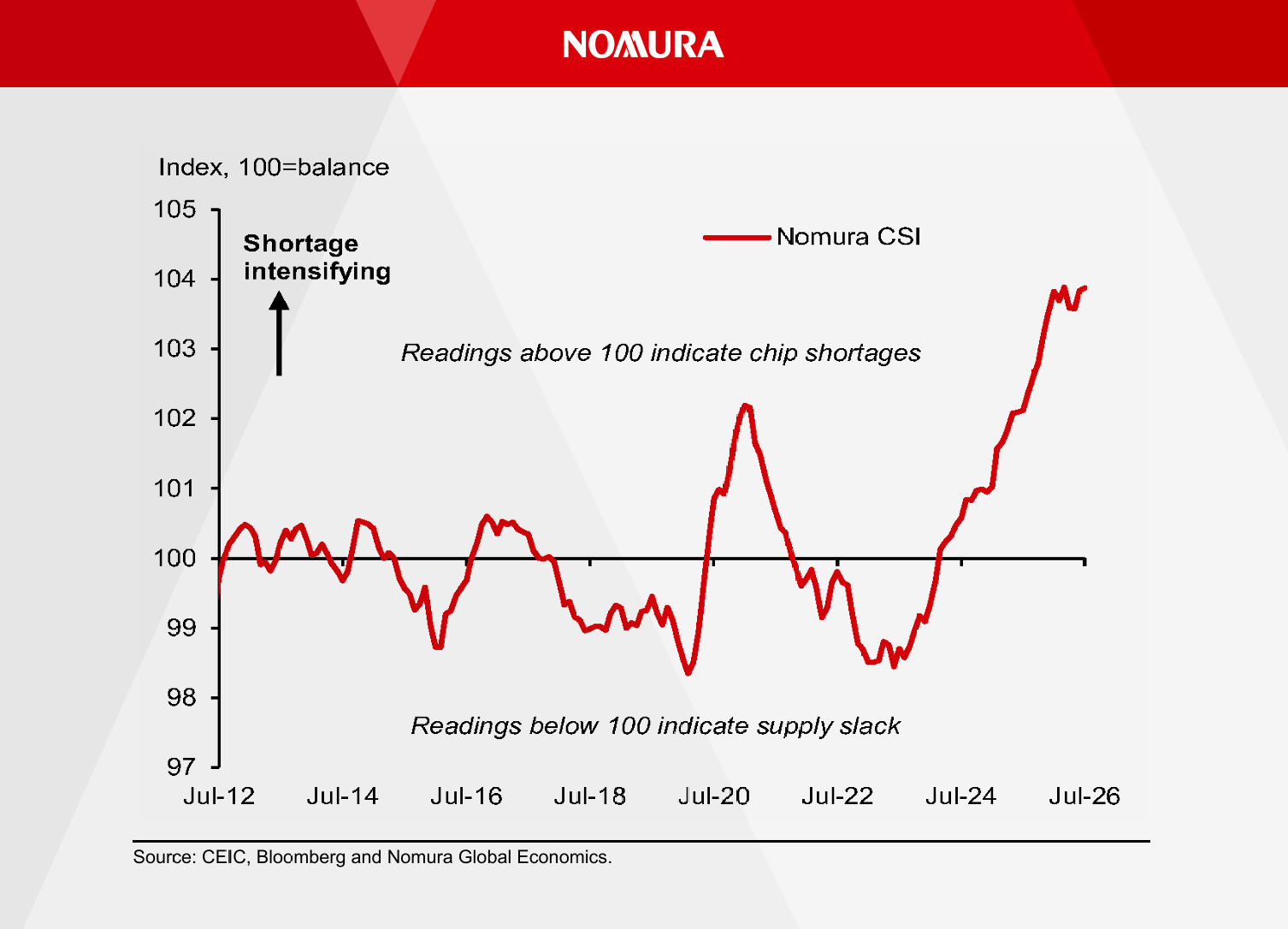
The index, spanning the full market cycle, is centered on 100, where demand and deliverable supply are in balance. Readings above 100 signal chip shortages, while those below 100 indicate excess supply. The distance from 100 measures the size of the imbalance, and the movement shows whether it is intensifying or easing.
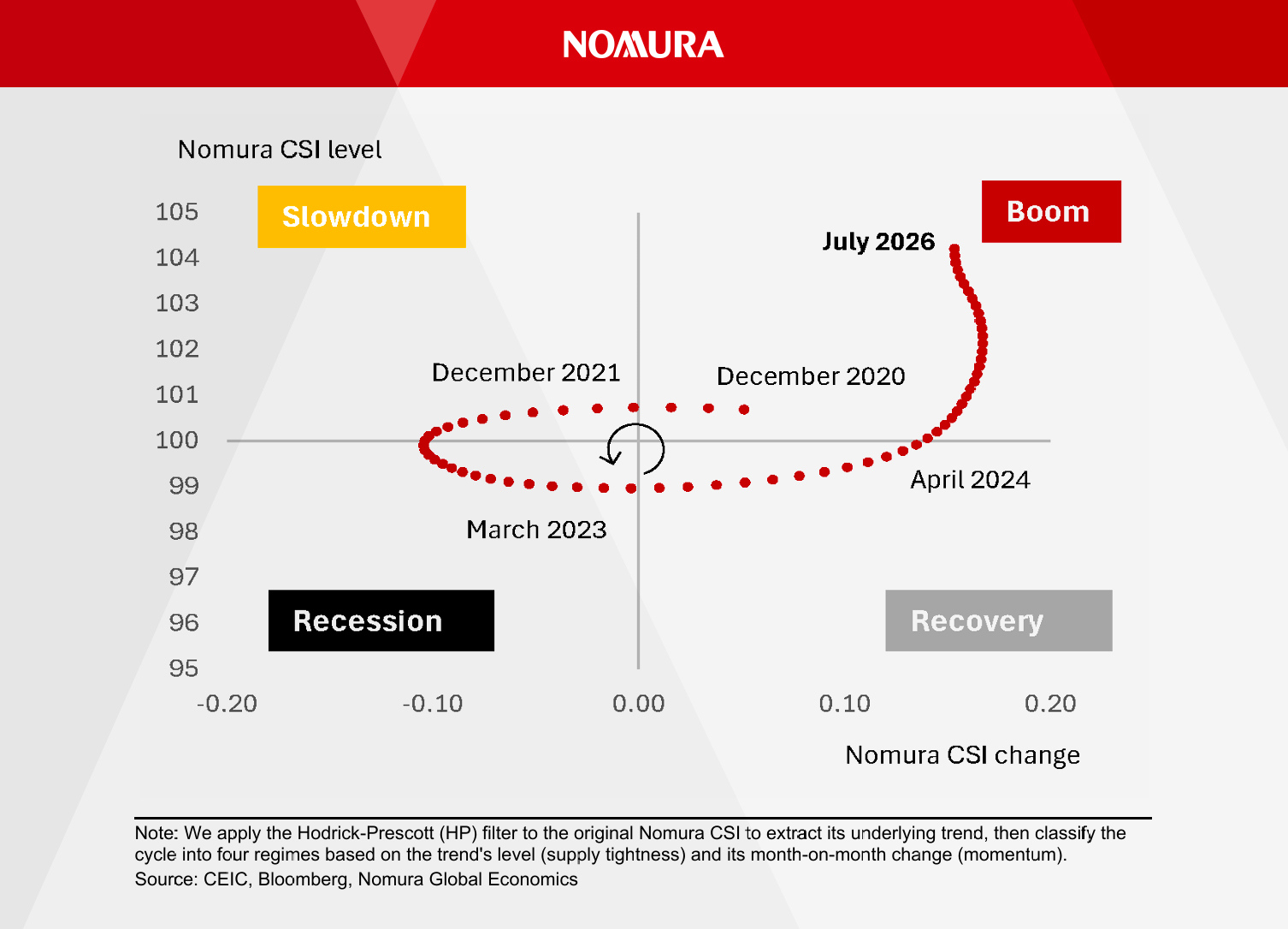
We built a CSI clock that splits the cycle into four stages along two axes. Starting from the bottom-right and moving anticlockwise, the chip cycle rotates from recovery to boom, then enters a slowdown, and finally a recession.
The latest Nomura CSI reading for July is close to a record high at 103.8. Recent monthly moves have been modest, suggesting no confirmed turn in the shortage cycle. While shortages may ease at the margin, a shift into supply slack appears unlikely in the near term.
Nomura CSI remains deep in chip shortage territory
The semiconductor cycle through the lens of Nomura CSI
Historical decompositions reveal three distinct phases:
- Industry momentum drove the 2012-14 and 2016-18 upcycle.
- 2020-21 boom was driven largely by chip shortages despite weaker fundamentals.
- 2024-25 recovery was again powered by industry momentum.
The current cycle is different. It combines positive industry momentum with an exceptionally large shortage shock. Unlike 2021, shortages are now reinforcing the industry's own momentum.
This matters because shortage-led cycles tend to generate a more persistent price impulse. Our VAR results indicate that a shortage shock can sustain the semiconductor upcycle for an extended period. With the current upturn beginning in H2 2025, the model points to continued price strength through 2027 and beyond.
Conclusion
We believe the Nomura CSI offers a powerful framework for tracking the emerging AI-era business cycle. Updated monthly, it will gauge whether chip shortages are intensifying or easing, identify the underlying supply and demand drivers, and signal potential turning points. Combined with our thematic research and monthly updates, the Nomura CSI is expected to serve as an ongoing guide to AI-driven economic cycles.
To read the full report, click here.