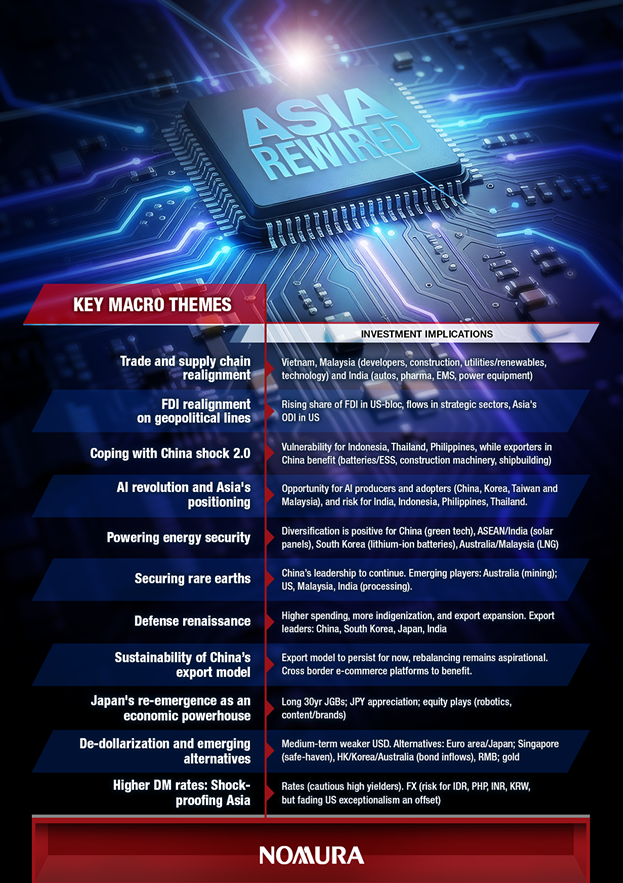
Asia stands at a critical juncture. The transition from a unipolar to a multipolar world order, China’s rise and the AI revolution have all unleashed simultaneous shocks, including supply-chain realignments, geoeconomic fragmentation, rising economic nationalism and increased volatility.
For a region that has thrived under open trading systems, these shifts are challenging the growth models of both developed and emerging Asian economies alike. In this article, we outline eleven interconnected themes rewiring Asia, how countries are responding to these shifts and the investment implications.
Eleven themes rewiring Asia
Trade realignment – slowly but surely: As firms look to diversify risks and hedge against the US, there is a continued shift in global supply chains and a proliferation of new trade agreements. Other than Vietnam, we see Indian (autos, pharma, EMS, power equipment) and Malaysian (property developers, construction, utilities/renewables, technology) equities as key beneficiaries.
Geopolitics is reshaping Asian FDI flows: Instead of efficiency, FDI is increasingly driven by geopolitical alignment, with a rising share of FDI within the US-aligned bloc, more flows into the strategic sectors and a surge in Asia’s investment in the US. The latter risks hollowing out of domestic manufacturing in Asia, while lower FDI inflows can create BOP pressure for the CA deficit economies. Economies that can maintain strategic neutrality should thrive. Singapore, India and Malaysia could benefit.
Coping with China shock 2.0: China's rising export share in EVs, batteries, solar, construction machinery and shipbuilding is increasing the vulnerability of Indonesia, Thailand and the Philippines (low-value manufacturing), as well as Korea and Japan (high-tech). Internationally expanding Chinese companies are likely to benefit in batteries/ESS, construction machinery and shipbuilding.
AI revolution and Asia's positioning: The AI revolution is redrawing Asia’s growth map. We expect the AI production economies to benefit first, while productivity gains across the AI adoption economies will likely accrue later. India and the Philippines face the challenge of managing the competitive threat from AI. We see equity opportunities for the AI producers in Asia across memory, foundry, AI server component, PCB, design and packaging.
Powering energy security: The Middle East conflict has galvanized Asia’s focus on diversification of energy mix, supply sources and boosting energy efficiency. We expect rising investment in renewables, nuclear and smart grids. This push towards diversification will be a positive for China (green tech exports), ASEAN (solar panels), South Korea (lithium-ion batteries), India (solar, grid) and Australia/Malaysia (LNG).
Securing rare earths: To loosen China’s dominance in processing, countries are diversifying through local refining, partnerships, recycling and tech innovation. China’s leadership in this space will likely weaken but not be broken over the next 10 years. Emerging players include Australia in mining, and US, Malaysia and India in processing.
Defense renaissance: After decades of decline, many Asian countries aim to raise their defense spending to 2.0-3.5% of GDP to boost national security. The focus is on indigenization and export expansion, which should lead to higher growth. We expect leading exporters in South Korea, Japan and India to benefit.
Sustainability of China’s export model: We expect the model to persist in the near term, due to its self-reinforcing nature, but as the trade surplus grows, it faces rising external frictions. Any correction will likely come through worsening terms of trade rather than deliberate rebalancing. Cross-border e-commerce platforms should gain.
Japan's re-emergence as an economic powerhouse: This is likely through an internal transformation consisting of "three hikes" (price, wages and rates), labor saving capex and sustainable wage hikes. Investing in super-long JGBs and theme-based Japanese equities (robotics, content/brands) should be attractive. We also expect JPY strength (USD/JPY at 145 by end-2027).
De-dollarization and emerging alternatives: We expect USD depreciation over the medium term and present evidence of alternatives to US assets/USD. These include the euro area and Japan (rising portfolio inflows); Singapore (relative safe haven, new wealth money); Hong Kong, Korea and Australia (bond inflows); RMB (increased trade settlement) and gold (central bank demand).
Higher DM rates – shock-proofing Asia: Asia ex-Japan rates have outperformed DM rates since the pandemic due to better fundamentals, but their beta to DM has risen in 2026. Higher DM yields should negatively impact rates in higher-yielding markets, but our strategy team judges that there are still some opportunities to receive rates, notably in Korea and Thailand. On FX, we expect weaker local Asia ex-Japan FX due to negative BOP flow dynamics (IDR, PHP, INR and KRW), but fading US exceptionalism and de-dollarization themes may be offsets.
Overall, the ongoing shifts are creating a world of winners and losers. A look across the themes shows China, Malaysia, South Korea, Australia and Singapore as likely beneficiaries across many areas, while Asia’s lower-income economies face greater challenges from the ongoing realignments. For investors who can navigate the complexity, Asia's transformation presents an opportunity to capture growth in the world's most dynamic region as it rewires itself for a new era.
To read our full report, click here.