In an investment landscape dominated by global monetary policy and artificial intelligence (AI)-led growth, constructing a resilient portfolio requires genuine diversification.
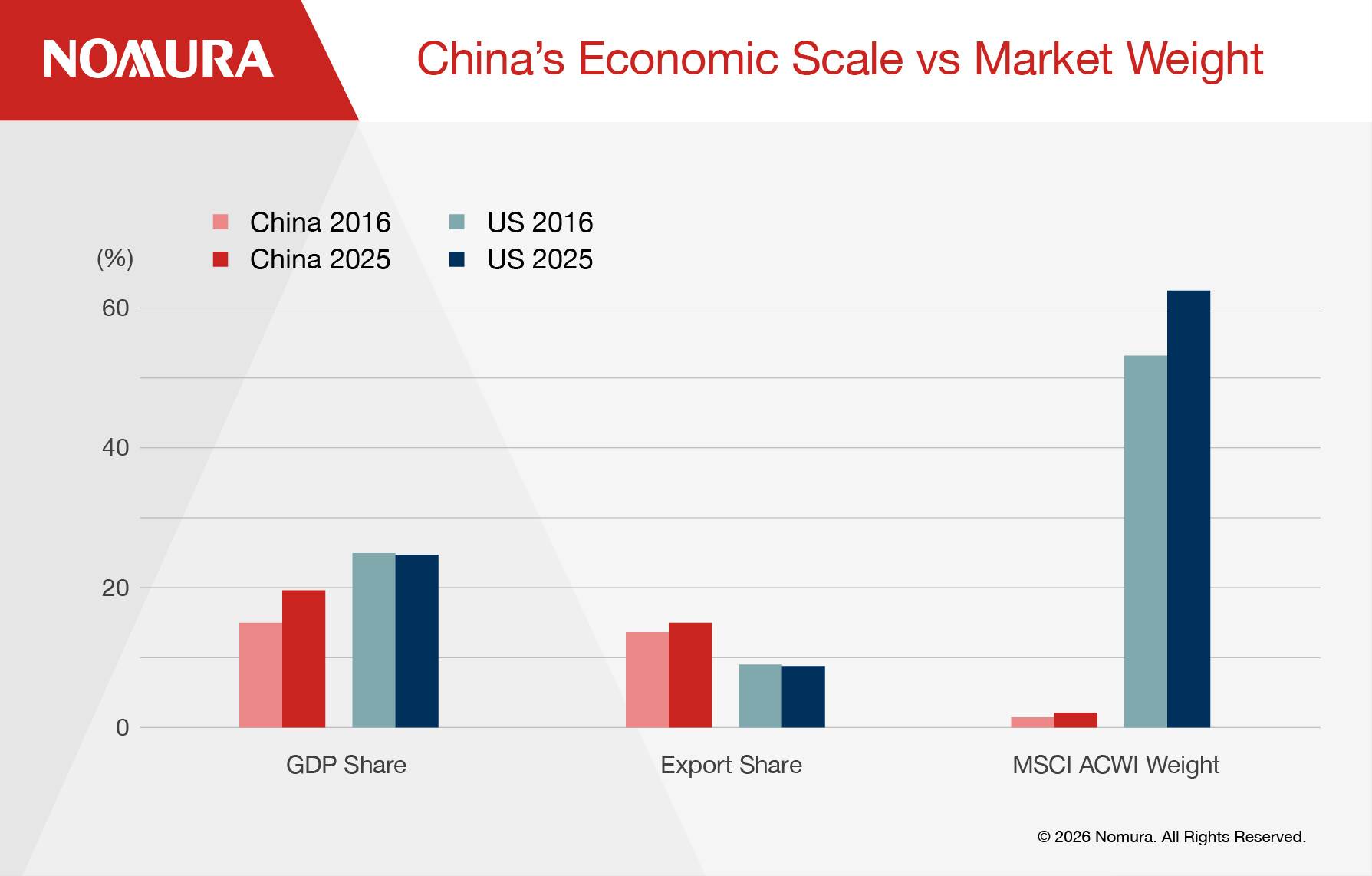
One such opportunity is China. Betting on selective, investable growth engines in the world’s second largest economy present an often-underutilized tool, not merely as an emerging market play, but as a strategic diversifier with a uniquely decoupled economic cycle from the US.
It also offers exposure to a resilient domestic consumption story at trough valuations. Long-term opportunities are available in the advanced manufacturing/AI ecosystem, healthcare, and domestic consumption sector. China’s manufacturing sector is globally competitive, in terms of quality-adjusted for price and well positioned to benefit from AI development. Moving further up the value chain is not only important for exports, but also can help unlock more domestic demand – a path out of the cyclical depression created by the deflation of the property market, which will further reinforce re-rating based on an alternative growth cycle.
Desynchronizations of US and Chinese economy and market cycles
The US is currently in a strong expansion stage and has been navigating a mid-to-late-cycle environment shaped by inflation, rising yields and the prospect of tighter monetary policies. China, by contrast, is closer to a cyclical trough, where the key question is how and when the economy will recover from the bottom.
Most global markets follow the US cycle, meaning many global portfolios are exposed to similar underlying forces: US inflation, Federal Reserve policy, Treasury yields and the US dollar. China follows a different cycle and can therefore serve as an effective diversifier against the US dollar cycle.
If the US cycle turns downwards or faces recessionary pressure, China may be less directly affected. If China’s own economic cycle begins to turn upwards, that would also present a strong opportunity. The desynchronization of the two economies therefore creates diversification value, particularly for investors with a longer time horizon.
This does not mean investors should expect an immediate recovery across the Chinese market. China is currently at a cyclical trough, and allocating to cyclical assets means positioning for a rebound in the next cycle. The timing and speed of that rebound remain uncertain.
A broad opportunity set: from high-dividend stocks to structural growth
As China’s economy is currently at a cyclical trough, many investors prefer high-dividend stocks. Their yields and returns may not be exceptional, but they can be relatively steady. But apart from dividend stocks, structural growth opportunities are also available, at much lower valuations than global peers.
Advanced manufacturing
China has the most globally complete and competitive manufacturing sector. The manufacturing strength can be further supported by development and global diffusion of AI technology. In the long term, physical AI can find many applications in China due to its large manufacturing and supply chain base and its ample and modern physical and energy infrastructure, as well as data regulation. EV, robotics, are good examples.
In case of EV, Chinese cars are technologically competitive/ While profitability pressures, geopolitics and overseas headwinds have depressed valuation, over the medium to long term, however, competitiveness remains the most important factor for company valuations because profitability ultimately stems from competitive strength. EVs therefore remain an area to watch. Robotics also have a more natural role to play given the demographic change and middle-class dominance – but require more technology development.
AI
China’s AI ecosystem is particularly unique: it is a self-contained system with its own foundries, AI models, applications, and robotics. While segments like servers and optical communications actively participate in global data center buildouts, the domestic market for technology substitution is also large and growing. This provides dual investment opportunities that are not merely derivatives of US tech performance.
Domestic substitution offers longer-term potential but may also call for patience. Companies are still expanding capacity and pursuing technological breakthroughs, with no stable earnings trajectory yet. While three to six months may be too short to assess returns, some companies may possibly offer substantial upside over a three-to-five-year horizon if they achieve breakthroughs and mass production and returns. If more of them choose offshore listing in HK, this segment will likely get more investor attention as well.
Healthcare
Chinese healthcare is something people should focus on as the sector’s strength lies in the maturity of China’s research and development (R&D) industry. Global pharmaceutical companies already outsource substantial research to China before licensing products or technologies back.
The industry supply chain demonstrates global competitiveness, particularly in the cost-effectiveness of R&D. The integration of AI could reinforce this advantage by helping biotech firms achieve better and faster research results. This competitive advantage is beginning to materialize but may not yet be fully reflected in market prices.
Domestic consumption
Technology is important not only for exports, but also for reviving domestic consumption – creating a path out of property-induced deflation. Sectors linked to China’s domestic consumption cycle, including many internet technology companies, trade at depressed multiples that reflect current macroeconomic pessimism. This allows investors to position for a cyclical rebound at attractive entry points. Valuations of these types of consumption proxy companies based on 2027 earnings estimates are mostly at, or close to historic trough valuations, in the offshore HK market. These companies offer a potential opportunity for investors who are willing to position for a rebound in the next market cycle.
Portfolio implementation
To be sure, adding Chinese exposure to your portfolio requires nuance and expertise. Successfully navigating the onshore-offshore market split, sector selection, and currency considerations demands deep, localized research. Institutions with dedicated investment and wealth management platforms can make the difference. They provide the essential “last mile” of insights, curated access, manager selection, and research that translates regional complexity into actionable portfolio decisions. For global allocators, partnering with such a platform can transform China from a theoretical diversifier into an executable, risk-managed allocation.
The bottom line
As such, viewing China solely through the lens of its immediate challenges misses its strategic portfolio utility. Its decoupled economic cycle, deep and unique industrial ecosystems, discounted valuations in key sectors, and emerging global champions in areas like healthcare collectively make it a compelling diversifier.