
Central Banks | 6 min read October 2026

Economics | 5 min read | October 2026
Clearing Triangular Debt Is Key to China's Recovery
How can China claw its way out of the six-year property slump?
Economics | 5 min read | October 2026
How can China claw its way out of the six-year property slump?

Chief China Economist

Asia Economist
China’s property sector downturn has now entered its sixth year and hit the economy harder than expected. While markets have called the bottom at the beginning of each year since 2023, the turnaround has yet to materialize.
This is largely because attention has been focused on falling home prices, developer defaults and strained local government finances. However, a key part of the crisis remains largely overlooked: the massive web of unpaid bills between companies which – according to the central bank – make up nearly a third of developers' liabilities. The unpaid bills remain a primary obstacle to an economic recovery, clogging credit channels and freezing working capital across entire supply chains.
Resolving these arrears is crucial to reviving domestic spending and stabilizing the property sector. This situation mirrors a prior inter-firm arrears problem of the 1990s, which was then dubbed the triangular debt crisis; overcoming that bottleneck three decades ago was what ultimately laid the foundation for China’s rapid, market-driven economic growth over the subsequent two decades.
Inter-firm arrears are rapidly converting a sector-specific problem into a broader macroeconomic challenge.
The transmission mechanism of monetary policy is a central topic of modern macroeconomics. While early Keynesian and monetarist paradigms focused primarily on price signals (interest rates) or money aggregates (M1/M2), contemporary literature has increasingly emphasized the credit channel. However, traditional literature often overlooks the trade credit channel, where non-financial firms function as shadow financial intermediaries through accounts receivable, commercial paper and construction advance financing.
In effect, monetary flows are split between bank channels and supply-chain credit networks. Under standard economic conditions, trade credit acts as a vital macroeconomic shock absorber during bank credit contractions. Large firms borrow on behalf of constrained partners. In doing so, suppliers benefit from deeper information, superior physical collateral repossession capabilities and potent operational enforcement.
Conversely, trade credit can become a systemic risk vector demonstrated by Kiyotaki and Moore’s (1997) model of inter-firm credit chains. When a major anchor debtor like a large property developer or state entity suffers from a liquidity crisis and defaults on its trade payables, the shock propagates downstream through multi-tiered supply networks. This creates an arrears trap whereby incoming receivables freeze, broad money velocity slows, and firms hoard cash or seek emergency loans.
Unlike most other economies, financing for Chinese developers depended heavily on presale payments from households and payables to up/downstream firms. According to a rare disclosure by the People’s Bank of China (PBoC) in January 2023, these two sources accounted for 32% and 30%, respectively, of developer liabilities in 2022. So, to understand the current challenges and find solutions, policymakers must look far beyond standard bank loans and Aggregate Financing data.
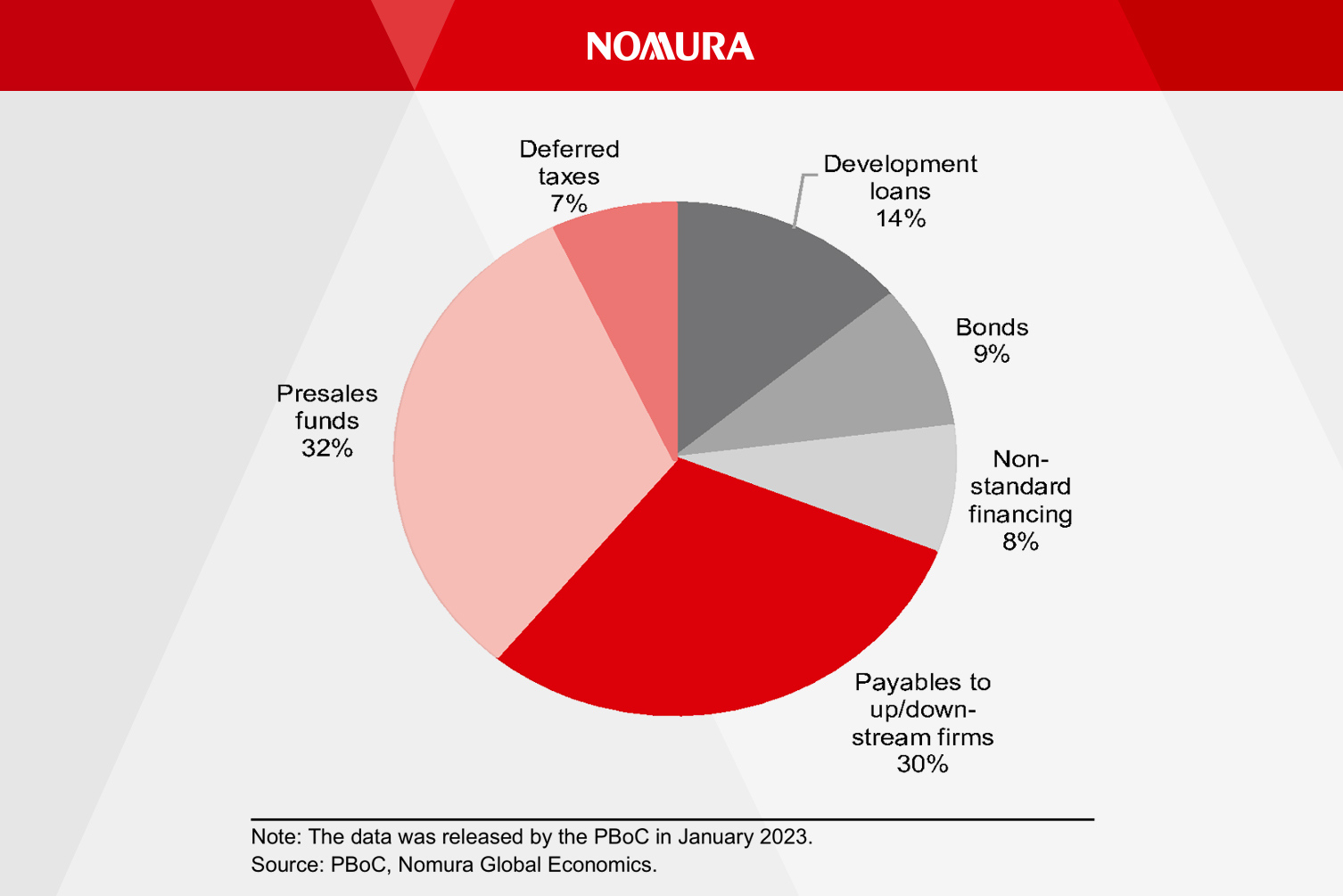
We estimate total developer payables to these up/downstream companies reached about RMB25 trillion by 2025. Based on developers' bond default and extension data, roughly 31% of this total (RMB7.8 trillion) could be classified as in arrears, or “problem trade credit”. This figure is more than double the estimated funding needed to resolve overdue deliveries of presold homes, highlighting how inter-firm arrears represent a larger, more systemic challenge than the presale setback that initially captured public attention.
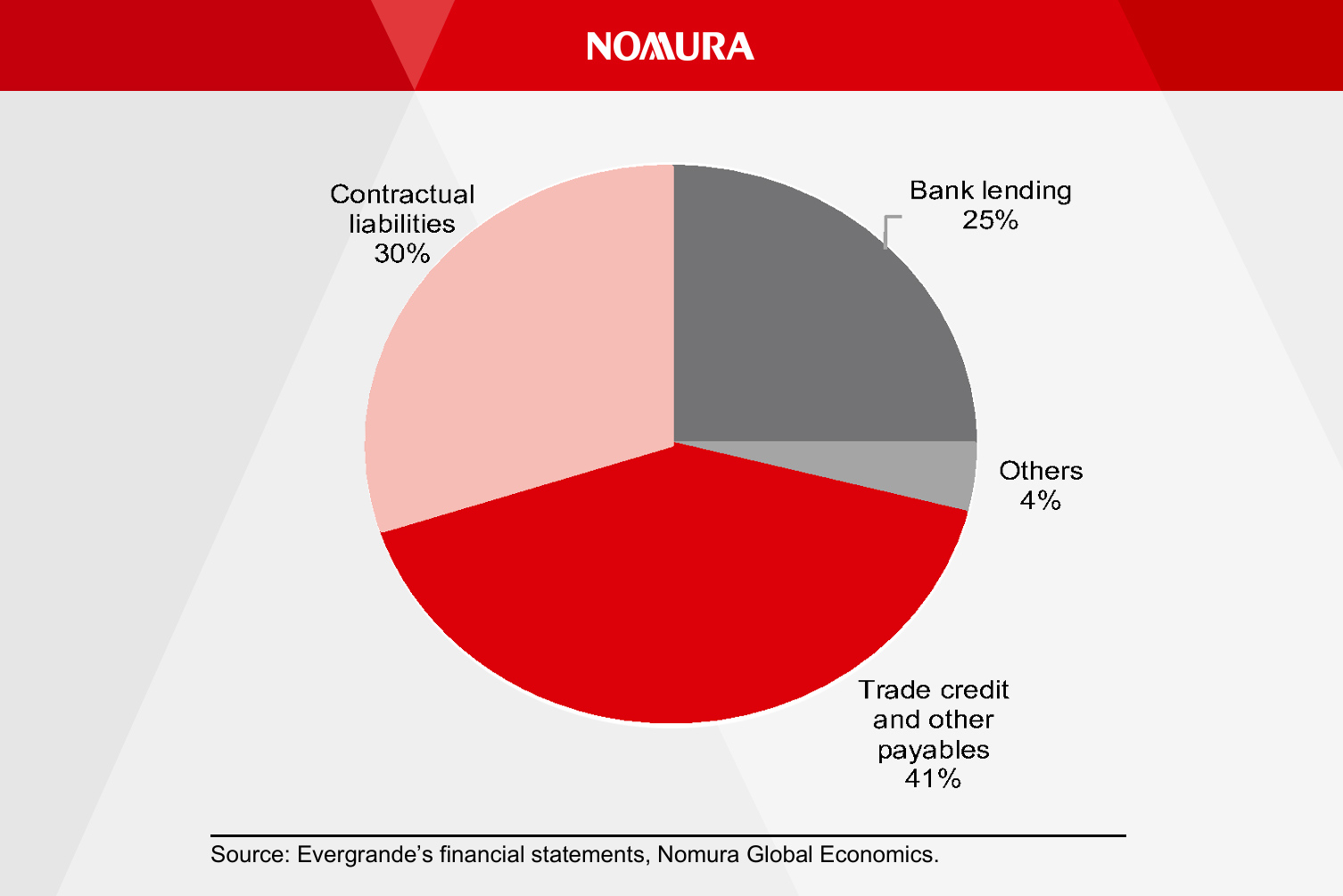
Take China Evergrande group as an example. The once largest Chinese developer’s trade credit to suppliers hit its largest liability at RMB1 trillion (i.e., 41% of its total debt). This amount exceeded its bank loans and pre-sale liabilities. Crucially, RMB326 billion of its commercial bills were overdue by the end of 2022, showing how developer distress turns into non-performing debt owed to suppliers.
Beijing has tackled similar issues before. The "triangular debt” in the early 1990s choked state-owned, collective and private enterprises alike. In July 1991, then-Vice Premier Zhu Rongji took personal charge of a debt-resolution campaign. He executed a targeted strategy focused on the root cause and rejected broad money creation to avoid hyperinflation. Audits revealed that over 70% of arrears came from unfunded fixed-asset investment projects. The government created a RMB50 billion “seed loans” fund to near-finished projects, and local owners were required to clear 3 to 4 RMB of downstream trade payables for every 1 RMB of central seed capital received. This created a multiplier effect, between 1991 and 1993, just RMB52.8 billion in total seed loans cleared over RMB307.7 billion in trade debt, achieving a multiplier exceeding 1:5.8. This unclogged supply chains and restarted the flow of money through the economy.
Some lessons can also be learned from Japan’s experience. The 2002 "Takenaka Plan" successfully resolved Japan’s lingering banking crisis and massive non-performing loan burden. This lesson shows that time alone doesn’t heal balance sheet impairment, and prolonged economic stagnation can only be overcome when authorities directly force the recognition, audit and structural disposal of non-performing assets.
Resolving the severe backlog of inter-company arrears is essential to reviving China’s domestic demand and stabilizing its real estate market. Given the special role of local governments in the surge of inter-firm arrears, Beijing also needs to overhaul local government finance. This means shifting municipal funding models away from a dependency on land sales toward more sustainable, diversified revenue streams.
Chief China Economist
Asia Economist
This content has been prepared by Nomura solely for information purposes, and is not an offer to buy or sell or provide (as the case may be) or a solicitation of an offer to buy or sell or enter into any agreement with respect to any security, product, service (including but not limited to investment advisory services) or investment. The opinions expressed in the content do not constitute investment advice and independent advice should be sought where appropriate.The content contains general information only and does not take into account the individual objectives, financial situation or needs of a person. All information, opinions and estimates expressed in the content are current as of the date of publication, are subject to change without notice, and may become outdated over time. To the extent that any materials or investment services on or referred to in the content are construed to be regulated activities under the local laws of any jurisdiction and are made available to persons resident in such jurisdiction, they shall only be made available through appropriately licenced Nomura entities in that jurisdiction or otherwise through Nomura entities that are exempt from applicable licensing and regulatory requirements in that jurisdiction. For more information please go to https://www.nomuraholdings.com/policy/terms.html.

Jump to all insights on Economics
Central Banks | 6 min read October 2026
Economics | 5 min read September 2026
Economics | 4 min read June 2026