The global build-out of artificial intelligence (AI) data centers is creating unexpected economic ripple effects across Asia: rising prices for consumer electronics due to higher chip prices that may, in turn, spark stubbornly higher goods prices next year.
Our analysis, supported by our proprietary Nomura Chip Shortage Index, suggests sustained chip-related input-cost pressures and the likelihood of further increases. When combined with higher energy costs and food prices driven by El Niño, Asia risks more persistent goods price inflation into 2027, which may complicate the monetary policy outlook.
Chipflation, driven by a shift in production away from computer and smartphone memory toward AI chips and higher data-center electricity costs, comes after two years of falling prices. In March, Asia’s consumer electronics inflation turned positive and accelerated to 5.8% year-on-year by September, outpacing both the US and euro area.
Consumer electronics CPI inflation
These items make up a small share of the CPI basket (0.13–1.76%) and thus have kept headline inflation manageable for now. However, that may change next year.
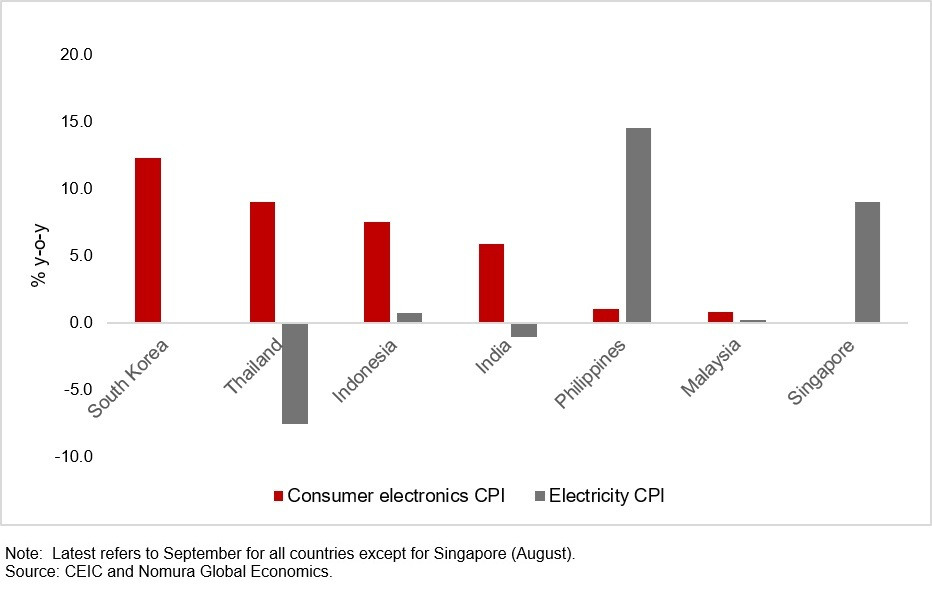
Within Asia, the turnaround in consumer electronics inflation has been broad-based, although the magnitude of price increases varies considerably across economies. South Korea has recorded the largest increase (12.3% y-o-y), followed by Thailand (9.0%) and Indonesia (7.5%). In contrast, price increases have been relatively modest in the Philippines, Malaysia and Singapore.
Among product categories, we have seen stronger inflationary pressures on computer prices than on mobile phones. In cumulative terms, computer, laptop and tablet prices have increased by an average of 6.7% year-to-date, compared with 3.1% for mobile handsets.
This is particularly pronounced in South Korea, where computer inflation reached 27.4% y-o-y in September 2026, significantly outpacing mobile phone inflation of 8.3%. India’s computer-related inflation reached 6.5% y-o-y, compared with 5.8% for mobile handsets. Similarly, Malaysia’s computer price inflation rose by 2.3% y-o-y in September, while mobile phone prices continued to decline by 0.4%.
Why this divergence? Memory and solid-state drives (SSDs) make up a much larger percentage of a computer's total bill of materials. Additionally, smartphone manufacturers are better positioned to cushion cost pressures through procurement arrangements and financing programs, delaying pass-through to consumers.
Nevertheless, sustained chip shortages are likely to increasingly push up smartphone prices, as inventories are depleted and supply contracts are repriced. Given the steeper rise in market prices, we believe further acceleration is in store for both.
Impact on headline and core CPI year-on-year rise in consumer electronics inflation
A sensitivity analysis shows that a 10% year-on-year rise in consumer electronics prices would add the most to headline inflation in Indonesia and South Korea (0.13 to 0.18 percentage points). The impact would be smaller elsewhere, around 0.06 percentage points in India, Singapore and the Philippines.
Consumer electronics versus electricity CPI (latest)
The divergences across Asia likely reflect firms’ decisions on balancing margins versus volumes, given consumer price sensitivity, inventory buffers, currency effects and technical differences in the items captured in individual CPI baskets and data lags. To the extent CPI data are lagged (due to inventory buffers), a further rise in consumer electronics inflation across economies is likely in store.
The emerging risk to Asia’s inflation from chipflation may compound existing pressures from elevated energy costs and food price inflation. Sustained cost increases could eventually spill over into other chip-intensive goods, like household appliances and vehicles, broadening the inflationary impulse.
For now, the monetary policy implications are limited but warrant close monitoring. Persistent goods price inflation could complicate the policy outlook, especially if it begins to influence inflation expectations.
Amid the challenges, investors and policymakers can take solace in the fact that electricity inflation, the second channel of chipflation, is under control.
While rising oil and gas prices are adding to the cost of power generation, electricity inflation is much lower than consumer electronics inflation across most of Asia, since governments have regulated energy prices to protect households.
Overall, consumer electronics have shifted from a traditional source of goods disinflation to experiencing broad-based price acceleration. We expect these pressures to persist, making chipflation an emerging upside risk to Asia’s inflation outlook.
The bottom line
The AI boom is rewriting the traditional playbook for electronics prices. After years of deflation, chipflation has introduced a new variable into Asia's complex inflation equation—one that investors and policymakers will need to watch closely as the data center build-out continues.
For our full analysis, read our report here.