Technology | 4 min read September 2026
Focused thinking | 5 min read | September 2026
An AI Architectural Evolution Fit for Business
Building auditable, controllable AI systems for regulated environments
Focused thinking | 5 min read | September 2026
Building auditable, controllable AI systems for regulated environments

Executive Director, International AI Centre of Excellence
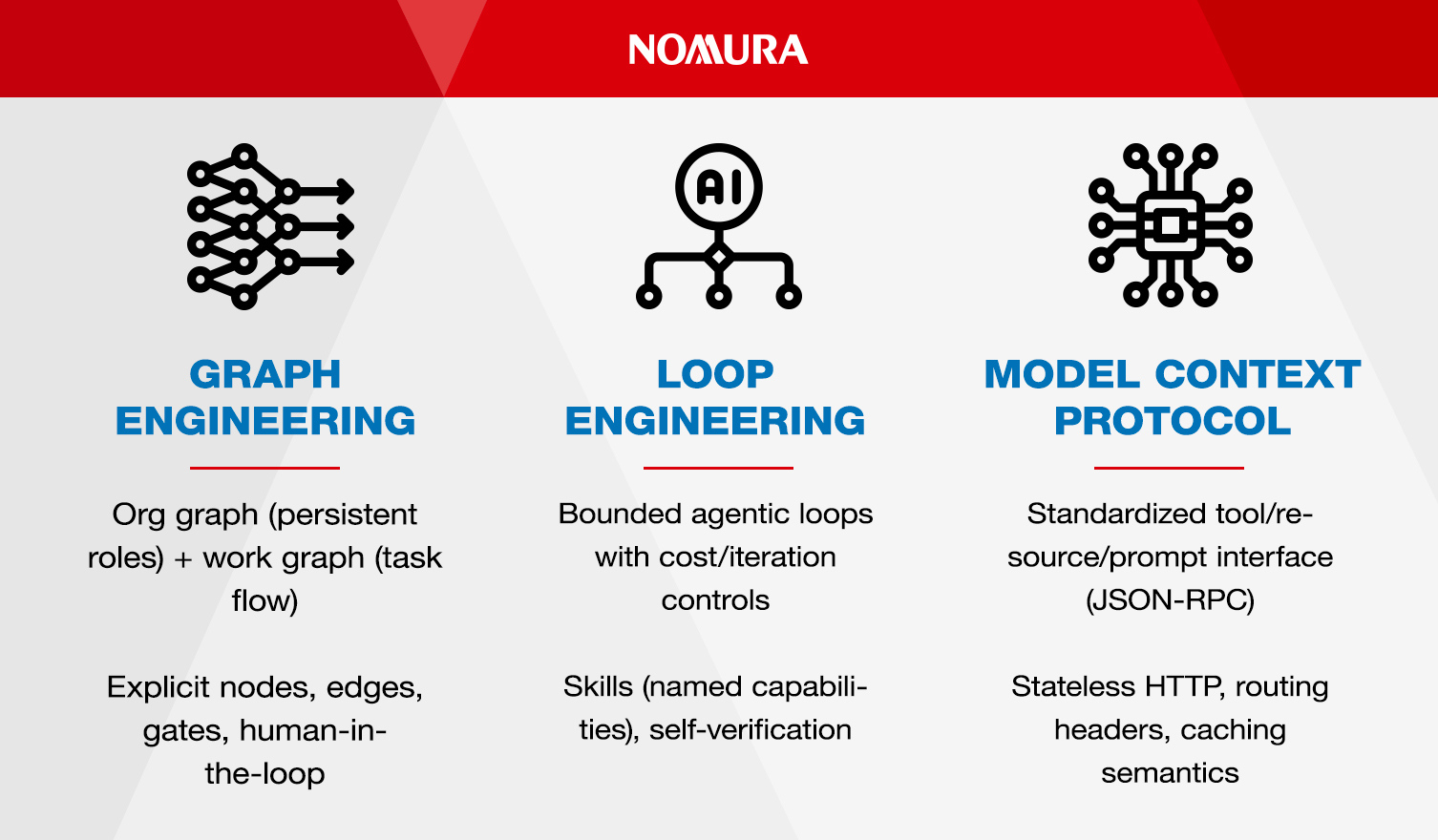
The way we build AI-powered systems is going through a rapid and consequential architectural evolution. The Model Context Protocol (MCP), a standardized interface of how AI models access tools, has matured through a phase of loop engineering to graph engineering – the discipline of composing those loops into structured, auditable, and controllable workflows.
Below, we highlight the arc of this evolution, considering regulatory and operational requirements.
MCP is to AI agents what HTTP is to the web. It decouples the intelligence layer (the model) from the execution layer (the tools), to enable connecting a model to any number of services without bespoke integration work for each one.
In financial services, a model equipped with MCP-compliant tools can query a market data feed, look up a counterparty's credit rating, retrieve a regulatory filing, or execute a structured query against a risk database—all through a single, auditable protocol.
While MCP solved the connection problem, a gap remained in solving the orchestration problem (i.e., when to call a tool). This leads us to the agentic loop.
The core insight behind agentic AI is simple: give a model a goal, a set of tools, and a loop. The model thinks (reads the goal and current state), acts (calls a tool), observes (reads the result), and repeats—until it judges the task complete.
The loop, however, has a fundamental problem: the agent controls its own exit, and nothing outside the loop decides when to stop exploring and providing solutions. While merely an inconvenience for a developer, for a trading desk, this becomes a liability.
Peter Steinberger, creator of the popular open-source AI project OpenClaw, and a respected voice in AI agents and developer tooling, had been closely tracking the evolution of agentic systems. He highlighted the emergence of /goal commands in Claude Code and Codex, which shifted agent workflows from manually managed loops to declarative, goal-driven execution.
To Steinberger, this signaled that the era of treating the loop as the fundamental unit of agent work was giving way to more structured approaches. The debate he sparked was not about whether loops were flawed, but whether a loop alone was sufficient as the core architectural primitive for systems expected to perform reliable, real-world work at scale.
This led to the shift towards graph engineering.
In this context, a graph is the loop with control reinserted. There is a gateway to ensure the agent doesn’t stop working until a condition is met, a check passes or a human approves. The work is remodeled to ensure that intelligence operates within a structure that can be reasoned about, audited, and corrected.
The graph engineering label largely reflects a vocabulary shift around established patterns—state machines, Directed Acyclic Graph (DAG) schedulers, and workflow engines have existed for decades. What is new is that the nodes in these graphs are now occupied by agents that can interpret tasks, use context, and make decisions—rather than executing fixed rules.
One thing to note is that the three paradigms (MCP, loop engineering and graph engineering) are not competing alternatives, but layers of an evolving architecture.
An org graph is the stable architecture of the system. It defines persistent roles and context (i.e., who does what, which agent has tools and permissions etc.).
A work graph is the execution play. It specifies current tasks, their flow and dynamic changes. It can also conduct (merge, split, reorder, or even cancel) tasks based on evidence and input gathered through execution.
In financial services, this distinction is important in that the org graph maps out defined capabilities and controls, including risk and compliance. Subsequently, the work graph maps to a specific workflow to generate results and reports.
Distinguishing when to use loops and graphs is important. Loops are most appropriate when the task at hand is sequential, and the stopping condition is well-defined and self-variable. It can also be used when the cost of a wrong exit is low and easily corrected, and if the workflow does not require human approval.
It would be best to use graphs when multiple specialized agents need to collaborate with specific tools, and parallel execution is required for analyses. Graphs are also useful when human checks and auditability are needed, especially for long-running workflows. Finally, failure isolation is also a key point, where a failure in one node should not cascade to other workflows. These are particularly applicable in financial services.
The financial services industry has adopted graph engineering because it provides benefits such as auditability, controlled autonomy, human validation and reproducible execution, all of which are in line with regulatory, risk and compliance requirements.
Teams that are actively using this architecture include capital markets, front-office trading, risk and compliance.
LangGraph (LangChain) is the most widely adopted framework, with more than 65 million monthly downloads, built around State/Nodes/Edges with native checkpointing and human-in-the-loop support. This allows internal teams to build agentic systems within the firm’s governed, secure environment, ensuring auditability throughout the process, and add gates where human oversight is required.
Teams with simpler requirements can use lighter-weight patterns. MCP-compliant tool integrations are available across the platform, providing the connective tissue that links graph nodes to Nomura's data and execution infrastructure.
The arc from MCP to loop engineering to graph engineering is not a story of one paradigm replacing another. It is a story of progressive layering: each new paradigm addresses the limitations of the previous one while preserving what made it valuable. MCP gave agents a standardized way to reach the world. Loop engineering gave agents the autonomy to pursue goals across multiple steps. Graph engineering gives those autonomous agents the structure, control, and auditability that production systems require.
Executive Director, International AI Centre of Excellence
This content has been prepared by Nomura solely for information purposes, and is not an offer to buy or sell or provide (as the case may be) or a solicitation of an offer to buy or sell or enter into any agreement with respect to any security, product, service (including but not limited to investment advisory services) or investment. The opinions expressed in the content do not constitute investment advice and independent advice should be sought where appropriate.The content contains general information only and does not take into account the individual objectives, financial situation or needs of a person. All information, opinions and estimates expressed in the content are current as of the date of publication, are subject to change without notice, and may become outdated over time. To the extent that any materials or investment services on or referred to in the content are construed to be regulated activities under the local laws of any jurisdiction and are made available to persons resident in such jurisdiction, they shall only be made available through appropriately licenced Nomura entities in that jurisdiction or otherwise through Nomura entities that are exempt from applicable licensing and regulatory requirements in that jurisdiction. For more information please go to https://www.nomuraholdings.com/policy/terms.html.
Jump to all insights on
Technology | 4 min read September 2026
Economics | 5 min read September 2026
Technology | 5 min read August 2026