
Geopolitics | 6 min read September 2026

Technology | 4 min read | September 2026
Tokenomics: The Hidden Economics of AI Adoption
Navigating AI’s value challenge by prioritizing spending
Technology | 4 min read | September 2026
Navigating AI’s value challenge by prioritizing spending

International Head, AI Center of Excellence
Artificial intelligence (AI) is transforming industries. From banking to healthcare, companies globally are investing billions to integrate AI across their operations, seeking to boost efficiency and gain insights that create competitive advantages.
Yet the results haven’t been linear, underscoring the need to prioritize spending on opportunities that can deliver the highest returns.
The following highlights the challenges companies face.
AI is seeing massive investment as illustrated below:
However, companies are struggling to immediately achieve the planned results:
Clearly the gap between investment and value is widening—and a significant reason lies in tokenomics, a strategic enabler for sustainable AI adoption.
Tokens are the bricks of AI—small, discrete units that form the foundation of every interaction. Just as a building isn’t constructed from a single slab, language models process text by breaking it into tokens, each representing roughly three-quarters of a word.
These tokens are more than technical abstractions; they are the economic currency of AI, behaving like volatile input costs rather than predictable subscriptions7, 8.
Efficiency in token usage mirrors construction: just as architects optimize brick counts to balance cost and design, organizations must refine prompts and instructions to maximize value. The shift from possessing intelligence to applying it efficiently has turned tokens into a competitive battleground—a resource that demands strategic allocation, much like capital or talent9.
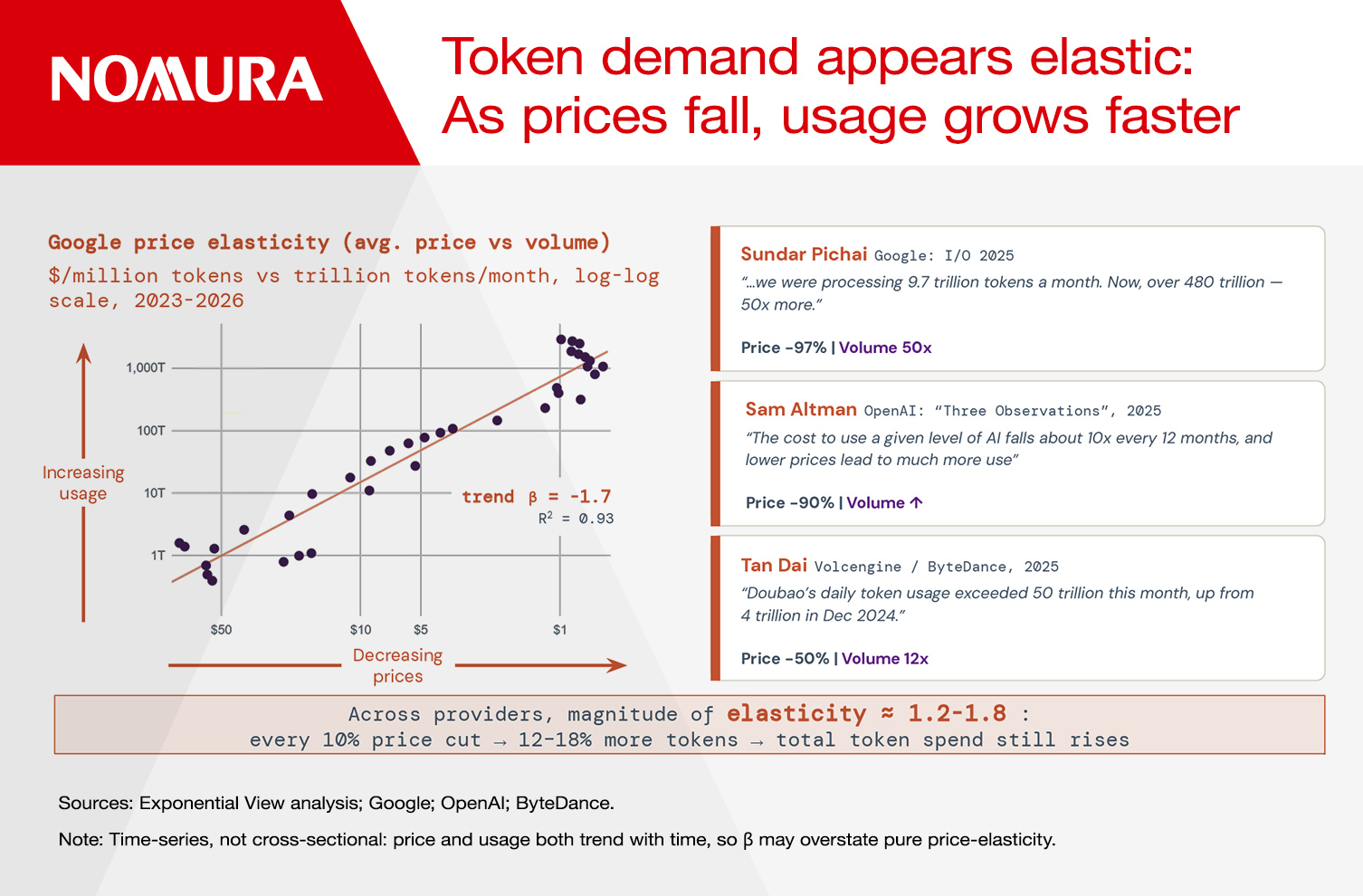
The AI pricing war of 2023–2025 compressed token costs dramatically. Research shows every 10% price reduction yields 12–18% more tokens consumed, with total spend still rising4. Enterprise AI budgets grew ~320% between 2024 and 202610.
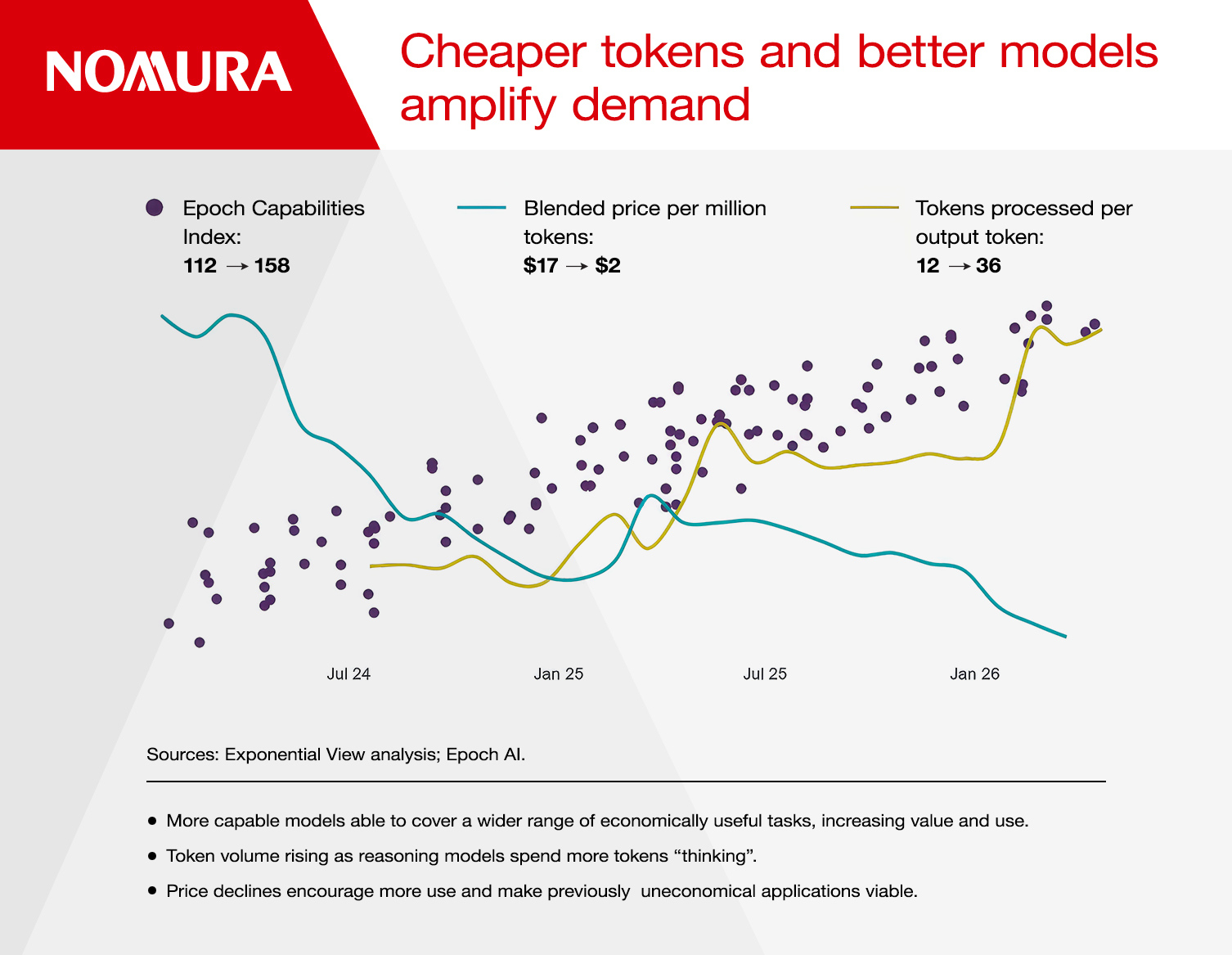
But this compression was deliberate market strategy—not equivalent reductions in compute costs. We are already seeing the correction:
The dynamics are non-linear: tokens consumed per task have surged even as unit prices fell, keeping effective cost per task often flat or rising12.
Context inflation
A single enterprise query can consume over 6,000 tokens in system prompts and retrieved documents before the user's question is even processed—over 85% of the cost remains invisible to the end user8, 13.
Agentic multiplication
Agentic AI—systems chaining multiple autonomous steps—compounds this dramatically7. As organizations move from chatbots to autonomous workflows, consumption grows exponentially.
The pricing cliff
Frontier deployment is increasingly constrained by cost, capacity, and marginal returns. The shift is from "what models can do" to the "the price and scarcity of inputs"11. Organizations built on artificially low prices will face a significant adjustment.
Controlling token economics
Organizations should manage tokens like capital—tracking return on intelligence for each AI project and allocating spend to opportunities with the highest returns9. Token governance should match the governance of capital and revenue13.
Small models are a strategic hedge
Compact models can outperform larger frontier models on specialized tasks like mathematical reasoning. Running it on dedicated hardware costs ~$50/day for 100M tokens versus ~$1,560/day on a frontier API — a 32x difference10. The practical lever is rightsizing models to tasks rather than defaulting to the most capable option 12.
On-premises deployment is returning
Self-hosted inference offers potentially over 50% cost savings versus API approaches over three years14. For high-volume, predictable workloads, the economics are compelling—and provide greater control over cost predictability.
The AI adoption race is entering its second phase. The first rewarded velocity—deploying models at scale. The second will reward discipline:
Tokenomics is not a technical curiosity. It is the economic framework that will determine which strategies survive. Organizations that treat tokens like capital, models like strategic hedges, and governance like a competitive advantage will outlast those chasing speed alone.
The future belongs to those who measure, optimize, and govern, not just those who spend.
Sources
International Head, AI Center of Excellence
This content has been prepared by Nomura solely for information purposes, and is not an offer to buy or sell or provide (as the case may be) or a solicitation of an offer to buy or sell or enter into any agreement with respect to any security, product, service (including but not limited to investment advisory services) or investment. The opinions expressed in the content do not constitute investment advice and independent advice should be sought where appropriate.The content contains general information only and does not take into account the individual objectives, financial situation or needs of a person. All information, opinions and estimates expressed in the content are current as of the date of publication, are subject to change without notice, and may become outdated over time. To the extent that any materials or investment services on or referred to in the content are construed to be regulated activities under the local laws of any jurisdiction and are made available to persons resident in such jurisdiction, they shall only be made available through appropriately licenced Nomura entities in that jurisdiction or otherwise through Nomura entities that are exempt from applicable licensing and regulatory requirements in that jurisdiction. For more information please go to https://www.nomuraholdings.com/policy/terms.html.

Jump to all insights on Technology
Geopolitics | 6 min read September 2026
Economics | 5 min read September 2026
Technology | 5 min read August 2026