
Economics | 4 min read June 2026
Central Banks | 4 min read | July 2026
Asia's El Niño Playbook: Eight Lessons from 25 Years of Shocks
Oil prices, irrigation and policy can sometimes matter more than rainfall
Central Banks | 4 min read | July 2026
Oil prices, irrigation and policy can sometimes matter more than rainfall

Chief Economist, India and Asia ex-Japan

Economist, Asia ex-Japan
El Niño has arrived, and it could intensify into a "super El Niño" by year-end. While Asia typically braces for drier conditions and heatwaves, oil prices, irrigation infrastructure and policy responses often matter more than rainfall alone in determining food price outcomes. This report distills 25 years of shocks into eight key implications for Asia.
Asia has weathered seven El Niño episodes in the past 25 years. Mild-to-moderate episodes typically shaved ~0.2pp off agricultural output growth and lifted food inflation by 0.6pp. Yet, during severe episodes, the relationship between El Niño and food prices breaks down; despite sharper crop losses, inflation has fallen. Three factors explain this paradox:
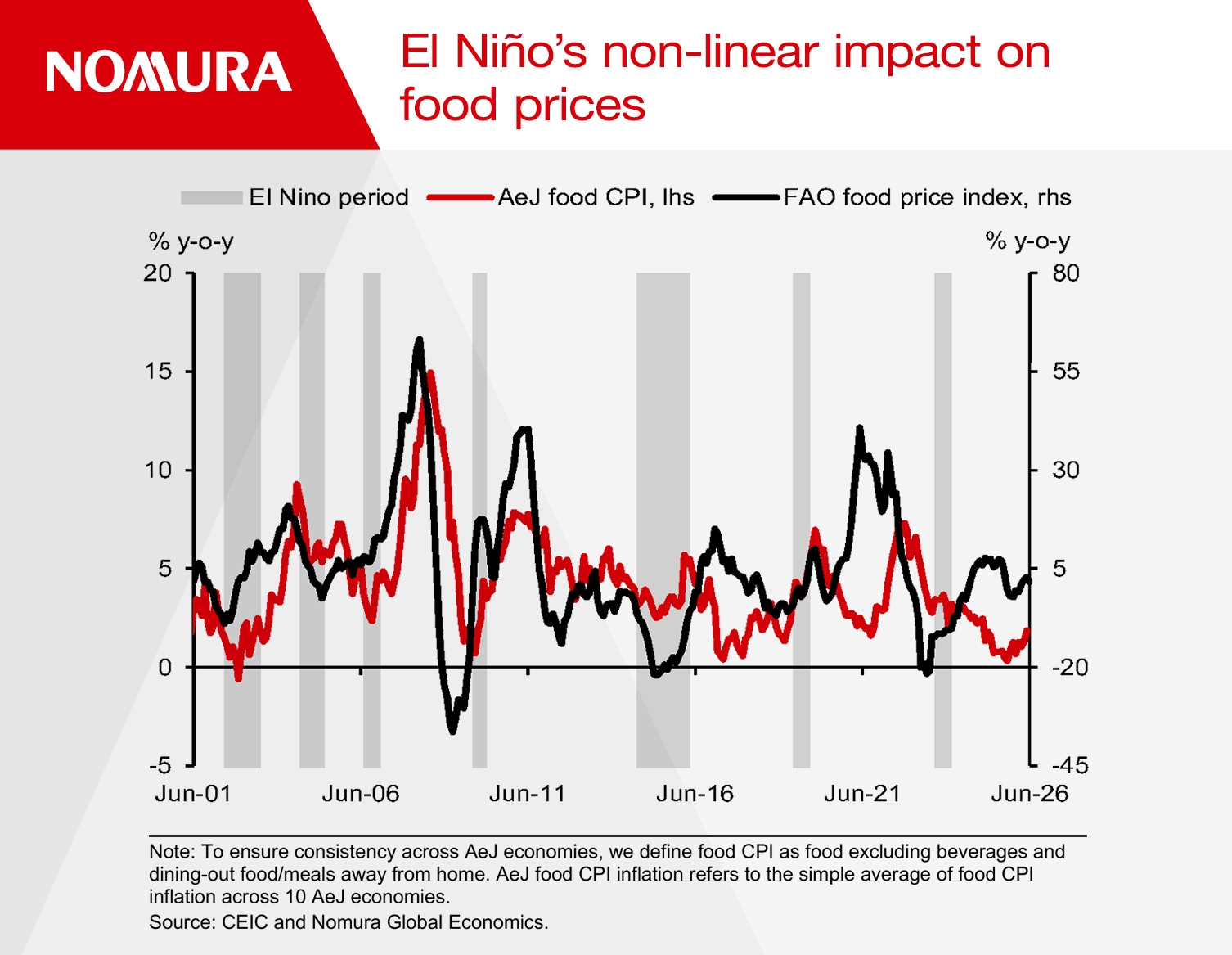
1. 2026 food inflation contained by buffers: Input costs like crude oil and urea have eased from April highs. Thailand’s reservoirs hold significantly more water than during past severe El Niño events, while India’s rice and wheat stocks stand at 3x and 2x buffer norms, cushioning price volatility.
2. 2027 inflation risks rise as buffers deplete: Once existing buffer stocks are depleted to stabilize prices this year, the region’s vulnerability will be higher next season. Droughts could hinder reservoir refill, pressuring irrigation-dependent crops, while potential export restrictions later this year may tighten global food supply.
3. Four commodities face outsized risks:
Rice: A rainfed Asian staple, with only 11.3% of global production exported in 2025/26. Domestic shortages or export curbs could trigger regional spillovers.
Palm oil: Reduced rainfall may reduce output in Malaysia and Indonesia.
Pulses: India’s buffer stocks remain low, risking price spikes.
Vegetables: Heatwaves accelerate spoilage, lifting prices.
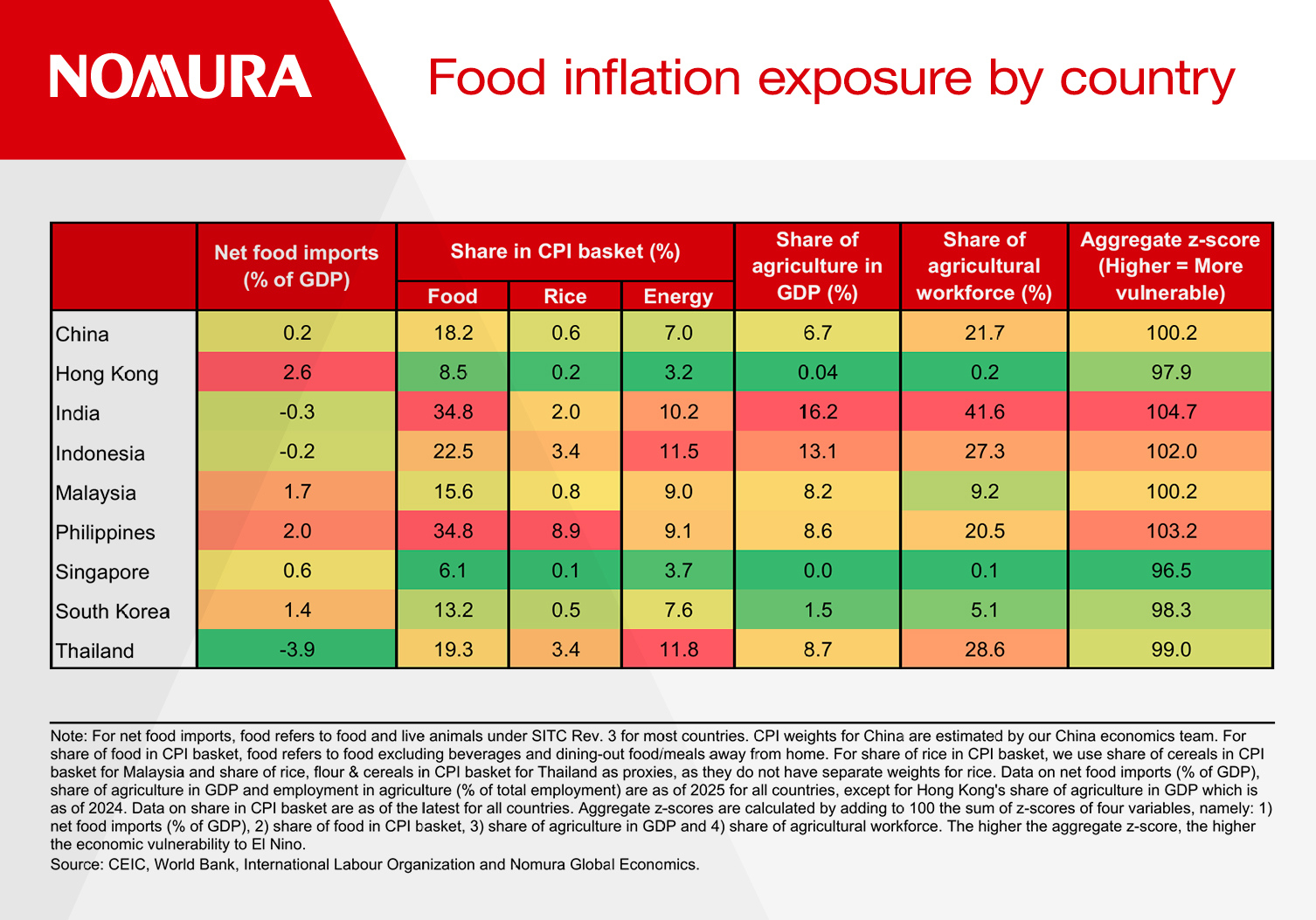
4. Philippines and India are most exposed to an El Niño shock: This reflects a larger share of food in their CPI baskets. The Philippines is particularly vulnerable to higher rice prices as a net food importer, with the staple accounting for 8.9% of its CPI basket.
However, these aggregates do not capture the full picture of vulnerability. For instance, while India and Thailand are both net food exporters, they are net importers of edible oil and wheat, respectively, exposing them to price risks in these food categories.
5. Stagflation threat: Advanced economies such as Singapore and South Korea are net importers of cereals and meat, so they could be impacted through higher imported inflation. For emerging Asia, El Niño poses a dual threat of a supply-side inflation shock and a demand-side growth shock. The latter stems from weaker farm incomes due to lower agricultural output as well as lower real disposable incomes owing to a pickup in food price inflation next year. Low- and middle-income households will likely be hardest hit.
6. Fiscal policy and supply measures as a first defense: Governments in India and Southeast Asia are already deploying drought mitigation, cloud seeding, water-efficient crops, crop insurance, seed reserves and solar pumps. If needed, they may be supplemented with subsidies, direct farmer aid or price controls.
7. Trade protectionism is a major risk in coming months: Asia has often used export restrictions or bans to control domestic food prices, but this would trigger price spikes for importing nations. We are seeing early signs of similar policies being imposed, including India’s ban on sugar exports until end of September.
Key risks to watch include Indian rice export restrictions, if monsoon shortfalls persist, and Indonesian or Malaysian palm oil curbs, if yields decline.
8. A dilemma for central banks: Monetary policy responses may not necessarily be hawkish. While food and fuel prices drive inflation expectations, emerging Asian economies, particularly Thailand and to some extent India, also face growth risks from weaker agricultural output and domestic demand. However, in the Philippines, the BSP would likely tighten policy if headline inflation rises, given its status as an orthodox inflation-targeting central bank.
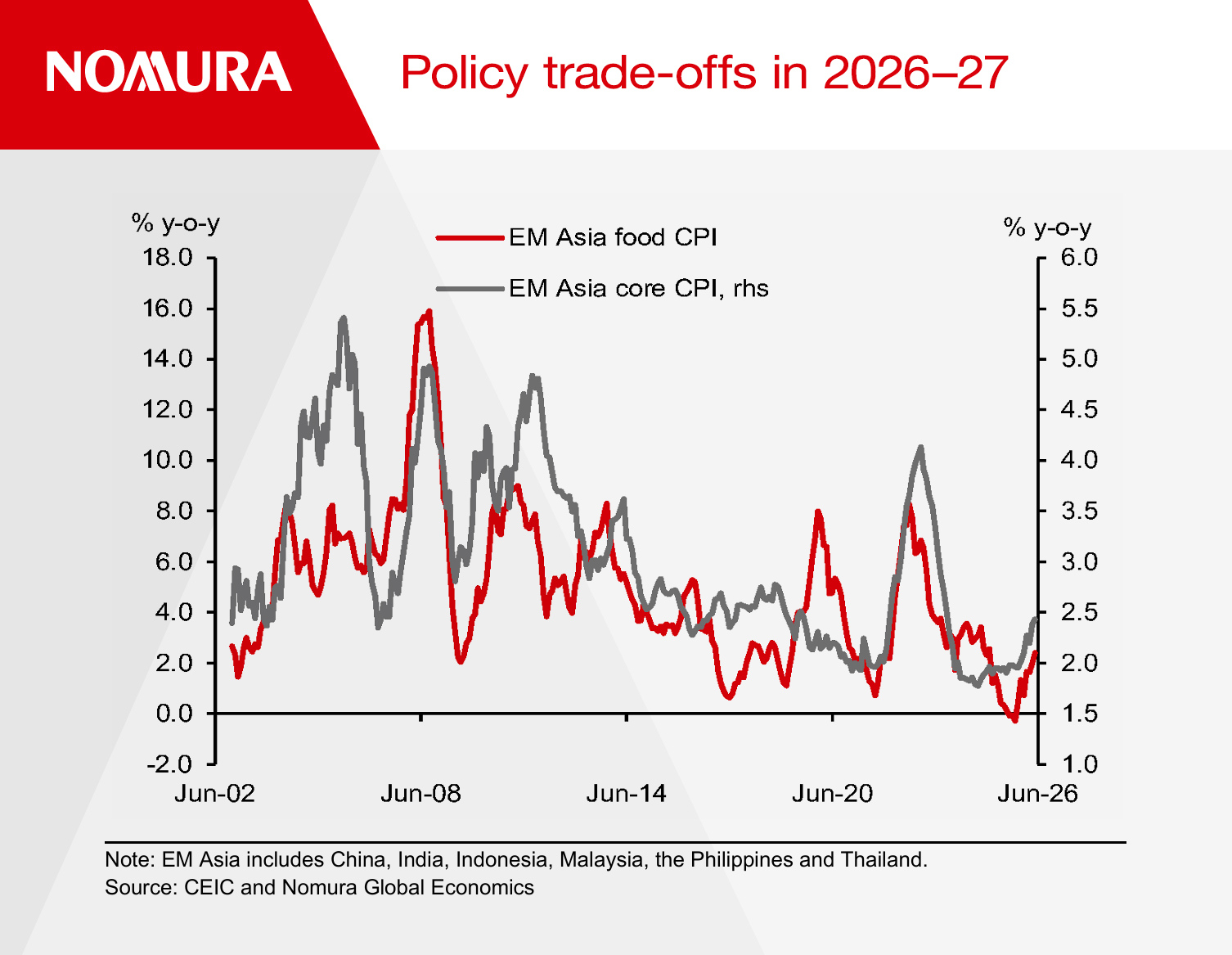
For most of Asia, the 2026-27 El Niño playbook will favor fiscal buffers and trade policy over monetary tightening. However, when buffers run dry next year, the policy calculus may shift as priorities are reassessed.
To read our full report, click here.
Chief Economist, India and Asia ex-Japan
Economist, Asia ex-Japan
This content has been prepared by Nomura solely for information purposes, and is not an offer to buy or sell or provide (as the case may be) or a solicitation of an offer to buy or sell or enter into any agreement with respect to any security, product, service (including but not limited to investment advisory services) or investment. The opinions expressed in the content do not constitute investment advice and independent advice should be sought where appropriate.The content contains general information only and does not take into account the individual objectives, financial situation or needs of a person. All information, opinions and estimates expressed in the content are current as of the date of publication, are subject to change without notice, and may become outdated over time. To the extent that any materials or investment services on or referred to in the content are construed to be regulated activities under the local laws of any jurisdiction and are made available to persons resident in such jurisdiction, they shall only be made available through appropriately licenced Nomura entities in that jurisdiction or otherwise through Nomura entities that are exempt from applicable licensing and regulatory requirements in that jurisdiction. For more information please go to https://www.nomuraholdings.com/policy/terms.html.

Jump to all insights on Central Banks
Economics | 4 min read June 2026
Economics | 6 min read May 2026