Nomura economists see more rate hikes, but well below consensus as policy rates are near or above neutral
Rob Subbaraman
Head of Global Macro Research
Aichi Amemiya
Senior US Economist
George Buckley
Chief UK & Euro Area Economist
Ting Lu
Chief China Economist
Kyohei Morita
Chief Economist, Japan
Euben Paracuelles
Week Ahead Podcast Host and Chief ASEAN Economist
Jeremy Schwartz
Senior US Economist
Sonal Varma
Chief Economist, India and Asia ex-Japan
US growth remains robust. We expect the Fed to deliver another hike in December.
We see Japan’s core CPI evolving in three stages towards 2028, with the second critical in determining the terminal policy rate.
Across broader Asia, sustained artificial intelligence (AI) demand and the gradual normalization of energy supply chains support a constructive regional outlook.
With sticky inflation and a renewed rise in oil prices, we have incorporated additional rate hikes into our global monetary policy forecasts, though still significantly fewer than what markets are pricing.
Our forecasts diverge from consensus, as we view this is a resumption – rather than the start – of hiking cycles, as most policy rates are already near or above neutral levels and much of the current inflation is cost-push in nature, which should weigh on growth over time.
We now expect:
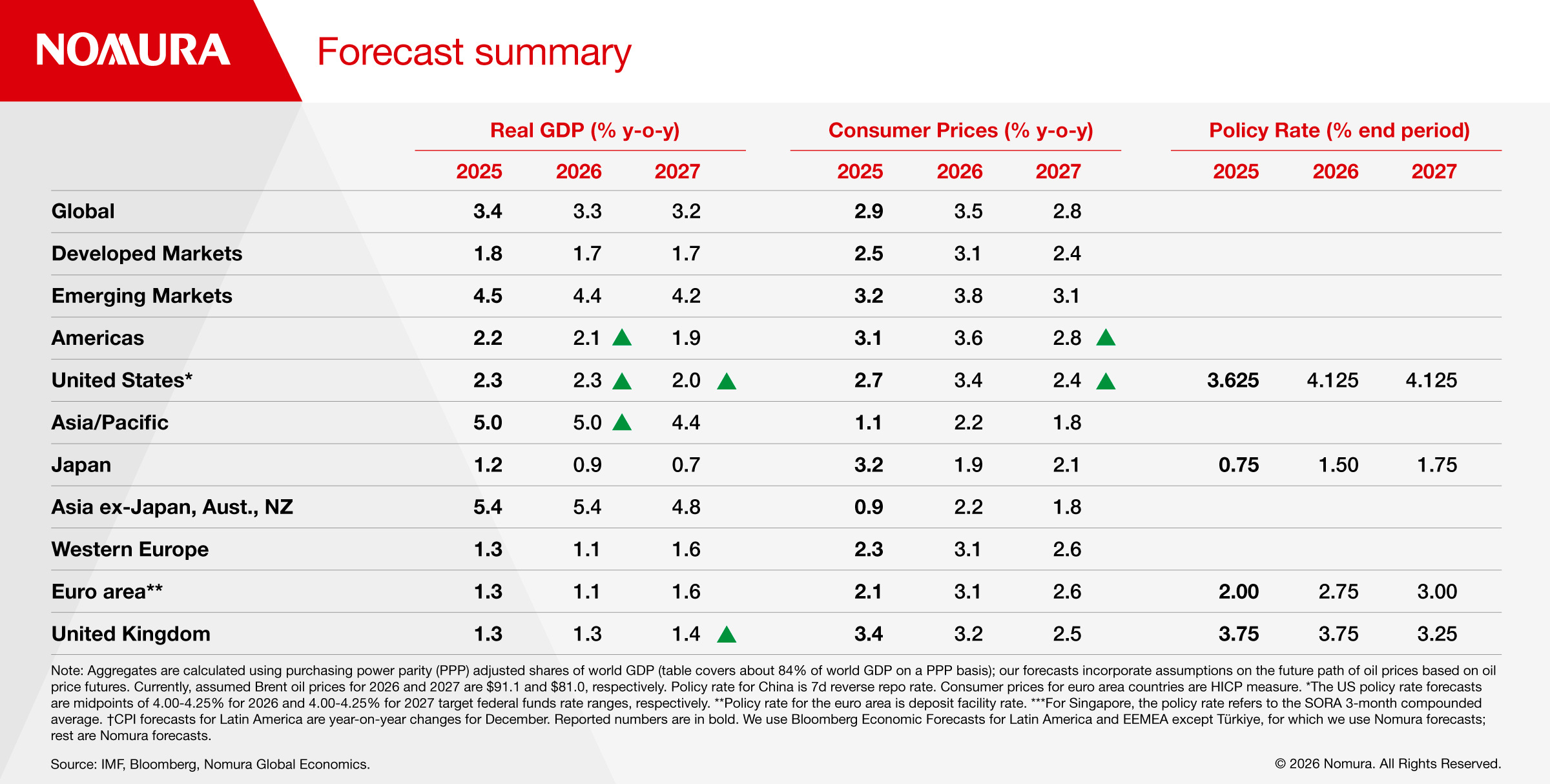
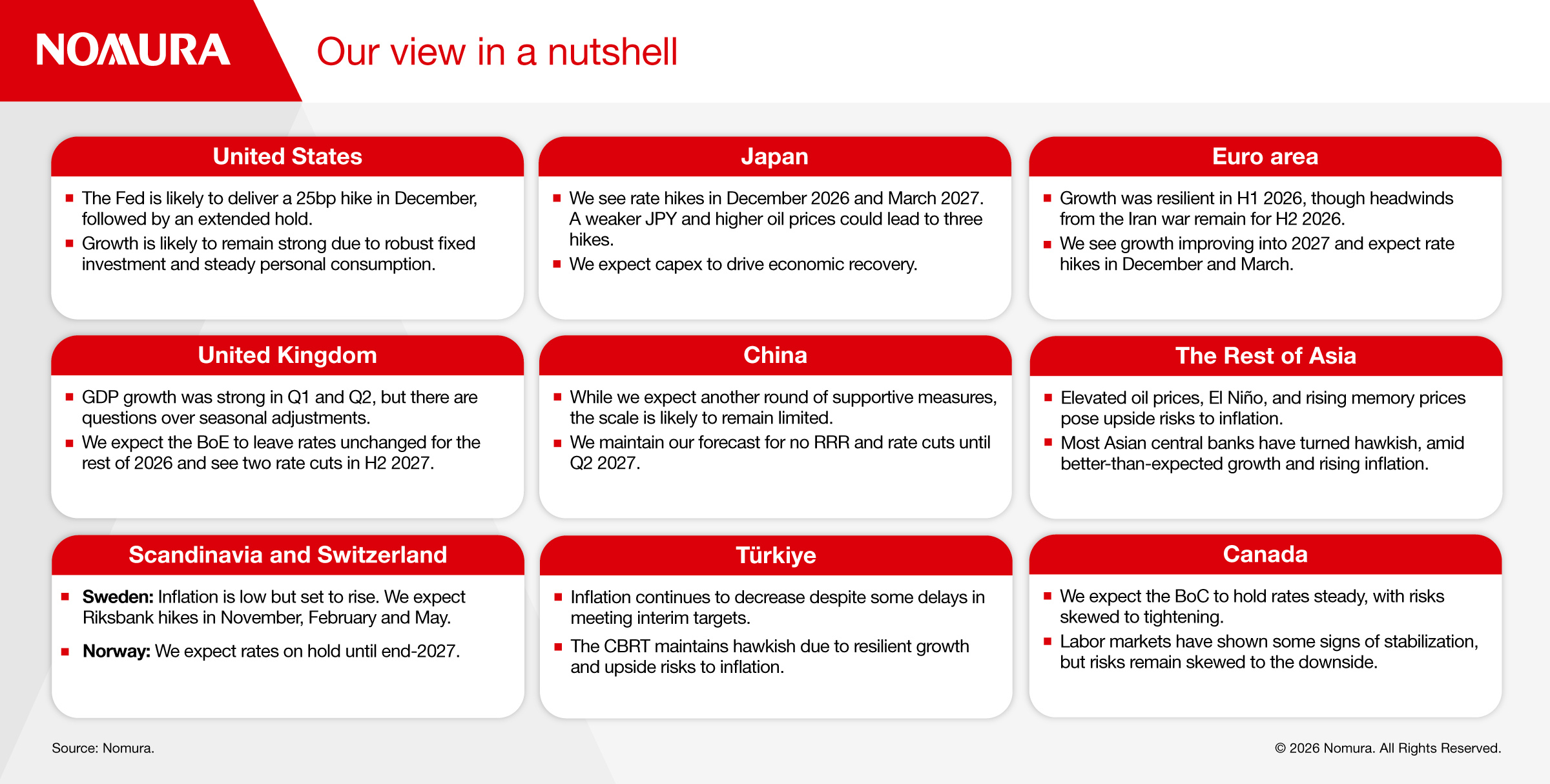
A hike in December by the US Federal Reserve followed by an extended hold through 2027, while the market has priced in three more rate increases.
Two more hikes by the European Central Bank in December 2026 and March 2027, compared with market expectations for two to three more hikes.
Two more hikes from the Bank of Japan against a market consensus of four or more.
None for the Bank of England and Bank of Canada against market pricing of around four for each.
Fewer hikes than consensus for Australia, India and Korea.
Fig. 1: Forecast summaryFig. 2: Our view in a nutshell
US: A December hike followed by an extended hold
Growth remains robust, driven by strong business investment and resilient consumer spending.
Economic activity
Business investment is increasingly broadening beyond AI, and capex-led growth is expected to continue. Despite higher energy prices, consumption accelerated in Q2, primarily due to higher tax refunds and strong income growth. We expect some negative payback in Q3; however, consumer weakness will likely reflect a modest momentum slowdown rather than a serious deterioration.
Inflation
Core inflation remains well above the Fed’s 2% target, with risks skewed to the upside. Renewed tensions in the Middle East have driven a sharp rise in energy prices, and crude oil prices have the potential to remain elevated in the coming months, increasing the risk of broader spillovers.
Policy
We now expect the Fed to deliver another 25 basis point (bp) hike in December. Recent data demonstrate little progress on inflation, with core personal consumption expenditure (PCE) essentially stuck at above 3% y-o-y, while the surge in energy prices has further tilted risks to the upside. Beyond 2026, anticipated disinflation will likely allow the Fed to stay on hold in 2027.
Euro area: ECB call updated
We now expect the Bank to raise rates in December 2026 and March 2027, bringing the depo rate to 3.00%.
Economic activity
GDP growth accelerated in Q2, despite widely expected headwinds from the Iran war and higher energy prices. However, if we exclude volatile Ireland from our calculations, growth has been quite stable since the start of 2024. Wage growth slowed in Q2, and inflation-driven wage effects are expected to appear only in the Q1 2027 data.
Inflation
A rise in the Harmonized Index of Consumer Prices (HICP) inflation, which measures the average change over time in the prices paid by households for consumer goods and services across European Union countries, was driven mainly by energy prices. Core inflation rose slightly in September, but there are not yet signs of second-round inflation effects. We expect inflation to remain elevated through year-end, with moderation next year hinging on developments in Iran.
Policy
The ECB raised the depo rate in September to 2.50%, with forecasts turning more hawkish than we had expected. These forecasts embed two additional rate hikes, yet the Bank still projects above-target inflation in 2028. Prolonged energy pressure from the Iran war, combined with resilient growth in the euro area – supported by Germany’s fiscal bazooka and Spain’s exceptional growth – add to inflationary pressures and justify further rate hikes in December and March.
Japan: Three stages of inflation
We expect Japan’s core CPI to evolve in three stages towards 2028, with the second critical in determining when the Bank of Japan (BOJ) reaches its terminal rate.
Economic activity
We updated our outlook following the release of Q2 GDP’s second estimates. The Takaichi cabinet’s decision to not issue a second FY26 supplementary budget – consistent with its policy of consolidating major expenditures in the initial budget – implies a decline in real public investment in FY27. However, we continue to expect Japan’s economy to stay on a recovery path, driven by capital spending, as there is a growing need to tackle the labor shortage through investment in technologies such as software, digitalization and automation.
Prices
We revisited our CPI outlook and remain confident that Japan’s core CPI (excluding fresh food) will evolve through three distinct stages towards 2028.
Stage 1: Inflation acceleration through Q1 2027, primarily driven by the pass-through of upstream and midstream corporate inflation – due to Middle East tensions – into downstream consumer prices.
Stage 2: Inflation deceleration from Q2 2027,driven by a decline in oil prices along the forward curve, as well as Nomura’s call for a stronger yen.
Stage 3: Inflation stabilization at around 2% y-o-y.
Policy
We expect the BOJ to raise its policy rate in December 2026 and March 2027, bringing it to 1.75% in our main scenario with 60% probability. Near-term rate hike(s) will be driven by risks rather than the BOJ’s main scenario of the economy and prices.
Sustaining yen stability over time could be a challenging task for the BOJ. As the “Impossible Trinity” says a central bank cannot simultaneously achieve a stable exchange rate, free capital flow and discretionary monetary policy. Under a floating exchange regime, the BOJ therefore monitors the currency indirectly through the lens of inflation.
Asia ex-Japan: Inflation risks keep most Asian central banks hawkish
In China, we expect weak domestic growth momentum to continue in the near term, despite some moderate policy rollouts recently. While we expect Beijing to introduce another round of supportive measures, the scale of such initiatives is likely to remain limited.
Given ample market liquidity and falling China Government Bond yields, we maintain our forecast for no cuts to the Reserve Requirement Ratio (the percentage of customer deposits that banks must keep in reserve) or policy rates until Q2 next year. At the same time, we expect the ongoing AI boom to widen both demographic and geographic inequality, which could further dent demand.
Across the rest of Asia, sustained AI demand and the gradual normalization of the energy supply chains support a constructive regional outlook. Malaysia and Singapore stand out as outperformers, while we remain cautious on Indonesia and Thailand.
Elevated oil prices, El Niño and rising memory prices pose upside risks to inflation. Against this backdrop, most Asian central banks have adopted a hawkish stance, reflecting stronger-than-expected growth and mounting inflation pressures.
At the country level, we expect two more rate hikes in Korea, bringing the terminal rate to 3.50% as growth and demand-driven inflation remain robust. In India, a faster rise in food and oil prices alongside firming core inflation momentum point to two hikes in Q4. Singapore should benefit from tech boom-related spillovers and strong domestic demand, lifting core inflation to above 2.0%.
This content has been prepared by Nomura solely for information purposes, and is not an offer to buy or sell or provide (as the case may be) or a solicitation of an offer to buy or sell or enter into any agreement with respect to any security, product, service (including but not limited to investment advisory services) or investment. The opinions expressed in the content do not constitute investment advice and independent advice should be sought where appropriate.The content contains general information only and does not take into account the individual objectives, financial situation or needs of a person. All information, opinions and estimates expressed in the content are current as of the date of publication, are subject to change without notice, and may become outdated over time. To the extent that any materials or investment services on or referred to in the content are construed to be regulated activities under the local laws of any jurisdiction and are made available to persons resident in such jurisdiction, they shall only be made available through appropriately licenced Nomura entities in that jurisdiction or otherwise through Nomura entities that are exempt from applicable licensing and regulatory requirements in that jurisdiction. For more information please go to https://www.nomuraholdings.com/policy/terms.html.