
Geopolitics | 6 min read September 2026

Geopolitics | 6 min read | September 2026
The Seeds of Political Change
Politics in Europe is sliding toward populism
Geopolitics | 6 min read | September 2026
Politics in Europe is sliding toward populism

Senior European Economist

Chief European Economist

European Economist
Several European countries will hold elections in the coming 18 months. These elections are of varying degrees of importance, but all can be seen as a barometer of the local — and wider European — political climate.
Right-wing populist parties, which are on the rise in Europe (Figure 1), are likely to make big gains across the board. In France, National Rally (RN) has the most seats of any single political party in the Assemblée. In Germany, Alternative for Germany (AfD) has the second-largest number of seats in the Bundestag. And in Spain, Vox has the third-most seats in the Congreso and is currently set to win more seats in next year’s election.
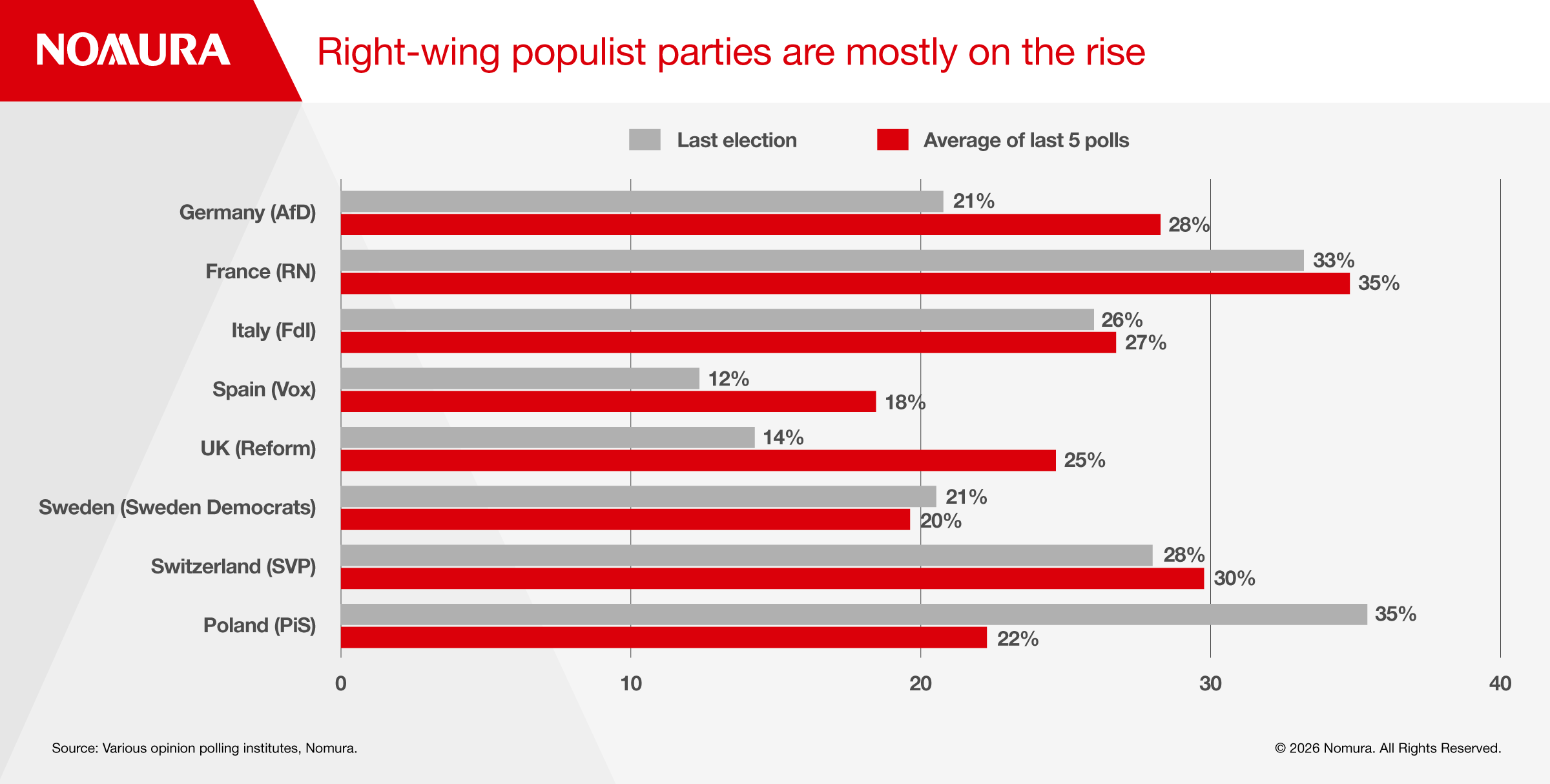
The growth of populist right-wing political parties in national parliaments means they may often influence policy directly by playing kingmaker. But they can also indirectly influence policy by driving the narrative. The AfD in Germany and Reform in the UK are both pushing mainstream political parties to engage in more hostile rhetoric and policies on migration and towards asylum seekers.
Five years ago, financial markets would not have seemed so at ease with such a prospect. But these populist right-wing political parties are now seen as more fiscally prudent. Italy’s Giorgia Meloni is the standard-bearer for this new wave of populist governments, showing investors that she can govern responsibly while focusing heavily on social issues, such as immigration, to keep grassroots supporters happy. The 10-year BTP–Bund spread is around 90bp, down from around 250bp when Meloni took office, underscoring how financial markets have rewarded her government’s fiscal prudence.
Now, financial markets are much more concerned about populist left-wing parties being elected due to their desire to increase spending, often paid for through higher borrowing or higher taxes, which would likely shut off the engines of already stuttering economies.
Chancellor Friedrich Merz’s popularity has declined significantly in recent months despite announcements of large government spending. Consumer confidence and views of the economy remain negative, and many Germans believe Merz has failed to deliver an economic turnaround. The continued decline of the nation’s flagship car production industry, with many announcements of job cuts, is fueling further discontent.
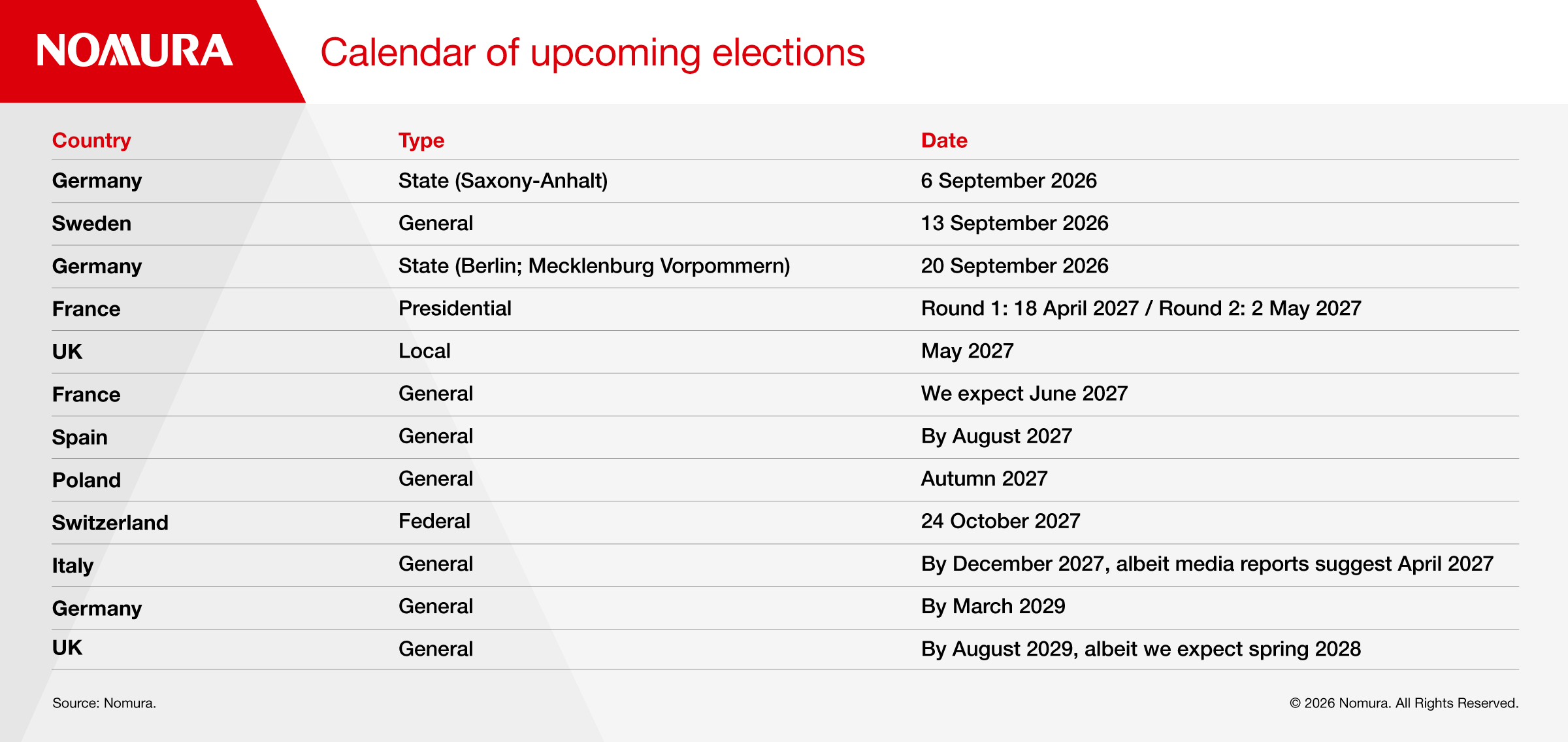
Merz is facing mounting pressure to stand down following another round of what he called “disastrous” results in two state elections held on September 20, after the already poor showing in Saxony-Anhalt on September 6. Merz has doubled down, though, and vowed to continue in office.
Most embarrassingly for Merz, the CDU won just 4.9% of the vote in Mecklenburg-Vorpommern, the worst state election result for the CDU since WWII. The far right populist AfD party won 38% of the vote, up from the 17% it achieved in 2021.
We believe the CDU’s continued weakness will weigh further on Merz’s popularity, and we believe it materially raises the risk of Merz being replaced by the end of 2027. If Merz is replaced, we do not expect a snap general election. In our view, the poor polling of the CDU and SPD mean they have no incentive to want elections, and therefore we believe the CDU and SPD would back any new CDU leader as chancellor.
We suspect markets think the most favorable outcome would be one where Merz is replaced sometime this year or next, and by someone more popular who has the momentum to press ahead with the necessary reforms to improve Germany’s economy and ensure the fiscal bazooka that Merz fought so hard for is finally spent — and spent appropriately.
The first round of France’s next presidential election will be held on April 18, 2027. Marine Le Pen will stand as the candidate for National Rally (RN), her third time — and her best chance at being elected president, according to the latest opinion polls.
We believe markets would react most negatively to a win by Jean-Luc Mélenchon (FI), as he would be fiscally profligate. Le Pen and Edouard Philippe (HOR), her nearest rival, would be seen as more market positive. Investors increasingly believe Le Pen would follow the model of Italy’s Meloni and be fiscally prudent while focusing on social issues to maintain support among grassroots voters.
France’s legislative elections are scheduled for 2029. However, we believe snap legislative elections will be called shortly after the election of a new president. The 2024 snap legislative elections resulted in a very fragmented Assemblée, which has made it challenging for the government to pass legislation. We believe the new parliament would be as fragmented as before, if not more fragmented.
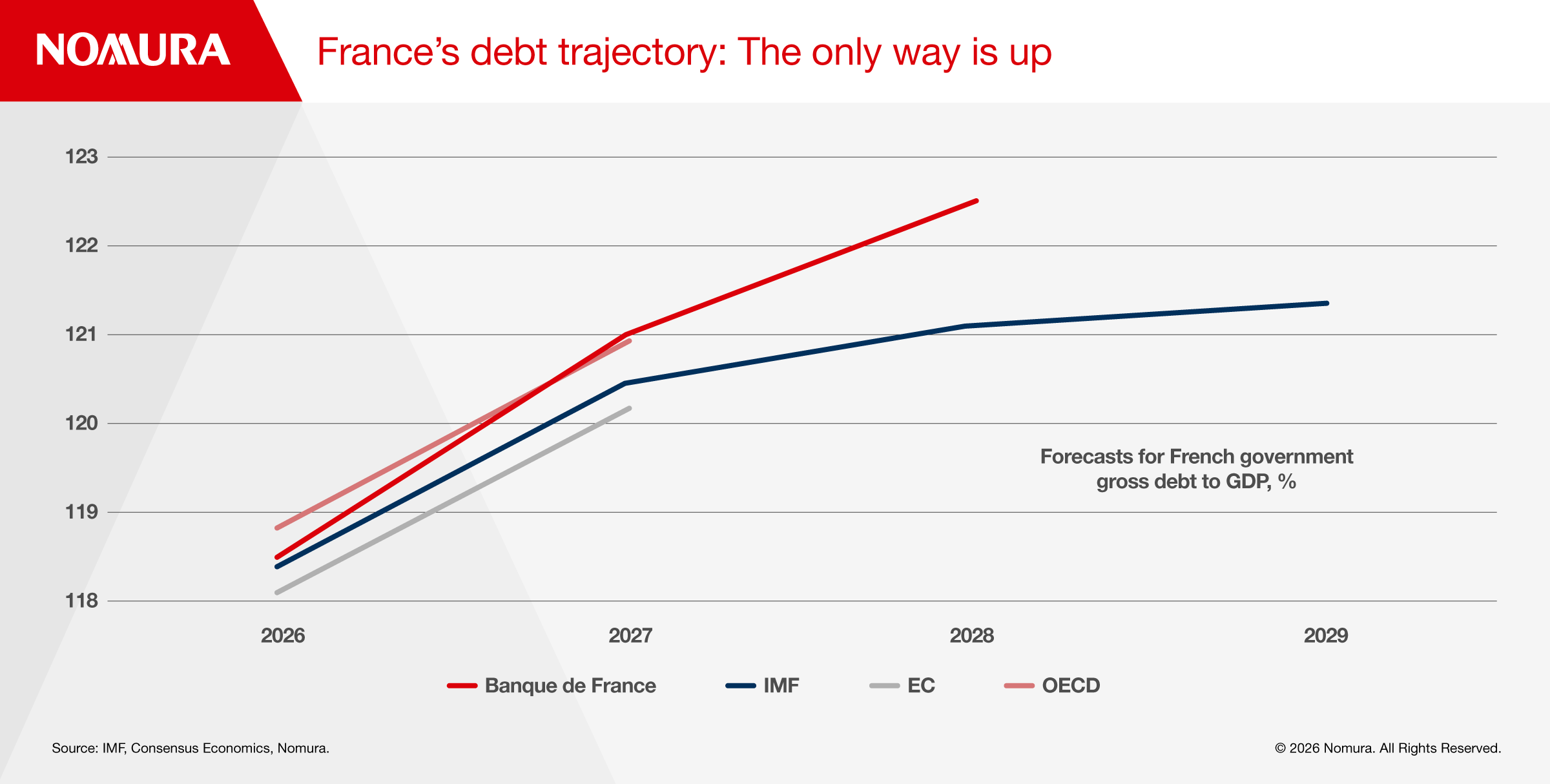
France’s real problem — irrespective of who succeeds Macron as president — is its inability to implement the structural reforms necessary to boost growth and to make the difficult choices needed to reduce its large primary deficit.
Pedro Sánchez, Spain’s prime minister and leader of the center-left PSOE (the Socialists), was re-elected in what were ultimately indecisive legislative elections in 2023. The Socialists have a minority government with coalition partner Sumar, and the government has struggled to implement its policy objectives.
Legislative elections must take place by August 2027, though opposition parties have been calling for a snap election. One might have expected the current government to be polling worse than it is owing to various scandals. That said, Spain’s economic exceptionalism in Europe has likely helped Sanchez’s government. GDP growth for Spain was 3.7% in 2024 and 2.6% in 2025, outperforming its European peers.
However, opinion polls have shifted rightwards, suggesting that Partido Popular (PP) and Vox would obtain a combined 51% of votes. Although Vox has historically been labelled as a far-right populist party, which mainstream parties have in the past refused to work with, the center-right PP appears increasingly willing to work with Vox.
We believe markets would view such a result positively because a right-wing PP–Vox coalition government would likely seek to further reduce Spain’s deficit and implement business and growth friendly policies.
The 10-year yield on Spanish government debt is already below that of France and Italy. Spain’s next general election result will be either more of the same or a further improved political and fiscal backdrop, so we see strong reasons for the 10-year SGB–Bund spread to tighten further. Ultimately, we remain structurally bullish on Spain.
To read the full report, click here.
Senior European Economist
Chief European Economist
European Economist
This content has been prepared by Nomura solely for information purposes, and is not an offer to buy or sell or provide (as the case may be) or a solicitation of an offer to buy or sell or enter into any agreement with respect to any security, product, service (including but not limited to investment advisory services) or investment. The opinions expressed in the content do not constitute investment advice and independent advice should be sought where appropriate.The content contains general information only and does not take into account the individual objectives, financial situation or needs of a person. All information, opinions and estimates expressed in the content are current as of the date of publication, are subject to change without notice, and may become outdated over time. To the extent that any materials or investment services on or referred to in the content are construed to be regulated activities under the local laws of any jurisdiction and are made available to persons resident in such jurisdiction, they shall only be made available through appropriately licenced Nomura entities in that jurisdiction or otherwise through Nomura entities that are exempt from applicable licensing and regulatory requirements in that jurisdiction. For more information please go to https://www.nomuraholdings.com/policy/terms.html.
Jump to all insights on Geopolitics
Geopolitics | 6 min read September 2026
Sustainability | 4 min read August 2026
Annual Outlook | 5 min read August 2026